
By Keston Perry
The Caribbean Sea has always been a watery highway—and a violent zone.
On October 14, 2025, two Trinidadian men, Chad Joseph and Rishi Samaroo, were killed when the United States struck the boat on which they were travelling in the Caribbean. The U.S. government justified these actions by labeling these men as narcotics traffickers. However, their families disputed this account and subsequently sued. [1] Imagine one day you are fishing in a neighboring water that you have known for a lifetime. The next, you're assassinated at sea at the behest of a corrupt, unlawful, waning power.
This saga was not only shockingly unjust and cruel, but it also revealed the sovereign quagmire of the region. It also made the political delusion of sovereignty in the region quite real. This is in part because the sea that separates our states also connects our lives. A Trinidadian fisherman can work in Venezuela, travel across the Caribbean, fish in waters that precede national boundaries, and encounter the military power of the United States in the middle of what we call our own region.
The Caribbean is an archipelago politically. It is an archipelago relationally. It is also an archipelago economically, ecologically, historically, and geopolitically. Yet we have claimed political forms that make us see ourselves as "islands"—discrete territories whose “sovereignty” can be superficially measured through national borders, constitutional arrangements, and diplomatic recognition.
It is this misnaming that makes our attempts to fit into a Western understanding of humanity truly troubling and consequential. The Caribbean has fallen into, what Sylvia Wynter and Katherine McKittrick call in “Unparalleled Catastrophe for Our Species?”, a "mimetic trap" (20). In their view, when colonized people adopt the Euro-American or Westernized standards of what it means to be “human,” they reinforce their own subjugation.
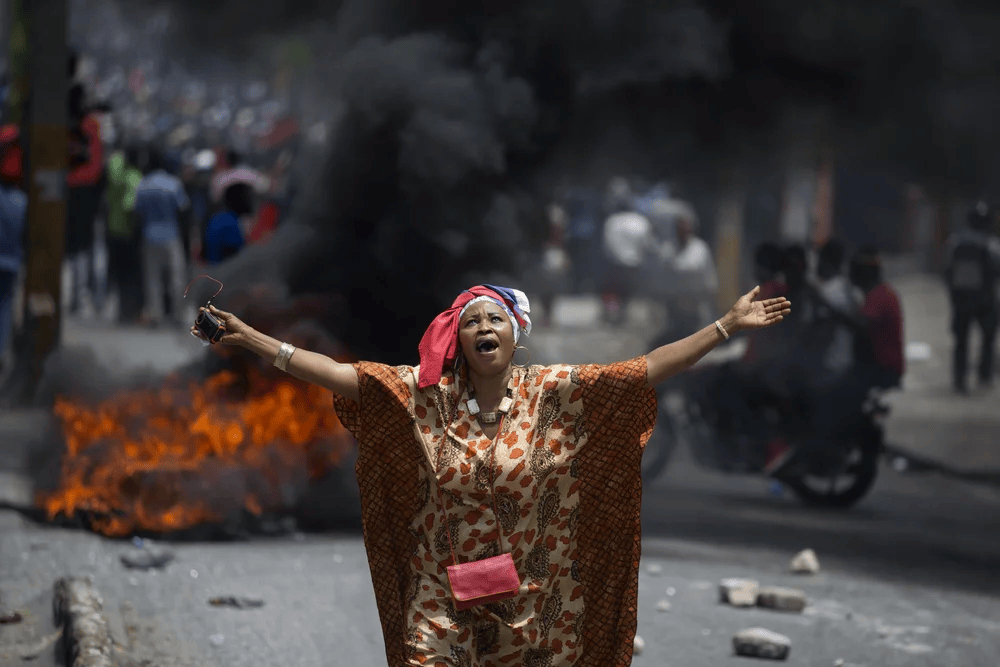
[Dieu-Nalio Chery, “A protester yells anti-government slogans in Port-au-Prince, Haiti,” 2019]
Édouard Glissant invited us to see ourselves in another way. His Caribbean is constituted through relation: interconnected histories, peoples, landscapes, cultural interchange, and processes of belonging that unfold across the sea. [2] This archipelago is therefore not merely a geography. It is a method of thinking against the containment of continental, imperial, and national ways of organizing the world. Yet relation is more than a metaphor for cultural interconnectedness. It is also material. People, labor, food, energy, capital, debt, and ecological processes move across borders, often under conditions they do not control.
The question is whether Caribbean sovereignty can be reorganized around these relations rather than confined to the territorial and institutional forms inherited from colonial rule. What happens if we take archipelagic thinking one step further? What would it mean to begin with the relations that already connect Caribbean life? What if relation is not only a way of understanding Caribbean identity, but a way of rethinking Caribbean sovereignty?
This matters because political independence did not produce the material conditions of collective freedom. The Caribbean adopted flags, constitutions, Westminster-style parliaments, borders, and national governments, but received no control over the economic and material conditions through which Caribbean life is reproduced. Formal sovereignty therefore coexisted with economic domination and geopolitical dependence.
George Lamming understood that colonialism operates not only through physical territory but through an occupied imagination. [3] To become free requires recovering the capacity to imagine oneself otherwise—to refuse the colonial world's insistence that our futures must remain as reductive replicas.
Sylvia Wynter pushes us further. Colonialism does not merely rule over territory. It governs the terms through which human beings become known to themselves. [4] It establishes conceptions of humanity, development, civilization, economy, nature, and progress as universal ideology. Decolonization is thus a struggle over the genres through which we know and imagine life.
Lloyd Best gave us another vocabulary for this problem. [5] Through refining a theory around Caribbean political economy, Best argued that the region's dependence was maintained not simply due to a shortage of capital, but because there was a failure of internal mechanisms to propel a broad transformation. Dependence was embedded in inherited structures of knowledge, representation, production, and external control. The Caribbean thus possessed political institutions while remaining economically and intellectually dependent.
Walter Rodney made the relationship between these entangled forms of domination abundantly clear. Development and underdevelopment were produced relationally. [6] Two sides of the same coin, as it were. Wealth expropriated to Europe was made or extracted from the organized impoverishment of Africa, the Caribbean, and Latin America. Economic sovereignty therefore could not be distinguished from the capacity to understand the historical processes of this dependency. It requires confronting the historical relations through which resources, labor, and productive capacities have been appropriated and unevenly distributed.
And Frantz Fanon warned us about what happens when formal political independence replaces true liberation. [7] The national comprador class can assume the very machinery of their erstwhile oppression within the colonial structure without transforming the relations that congealed its power.
The result is what C. L. R. James called “flag independence” —a condition in which formal political sovereignty coexists with enduring economic dependence and constrained popular freedom. [8] In this configuration, postcolonial elites can leverage their limited economic and geopolitical power to negotiate benefits from transnational capital while reproducing inequality, dispossession, and dependency at home. Caribbean governments thus exercise authority within national borders without fundamentally transforming the relations through which wealth, resources, and political power are distributed. Independence, in other words, does not necessarily mean that Caribbean people possess the material power to determine the conditions of their collective lives.
The contemporary politics of Prime Minister Kamla Persad-Bissessar in Trinidad and Tobago offers one vivid example. In a country confronting worsening inequality, an exacerbating crime situation, and dwindling energy incomes, her return to power raises the enduring question of whose interests the postcolonial state is ultimately organized to protect. The formal sovereignty of the state remains intact, even as economic, military, and political power continues to be shaped by forces beyond the state itself. In fact, her response to this crisis has been to redistribute funds upward to her financial backers, while stoking ethnic divisions and acting to further fragment and dispossess working-class communities. Trapped inside this imperial straitjacket of formal “sovereignty,” so-called leaders remain committed and tethered to economic, military, and political machinations of an external power—although some are more willing than others to acquiesce.
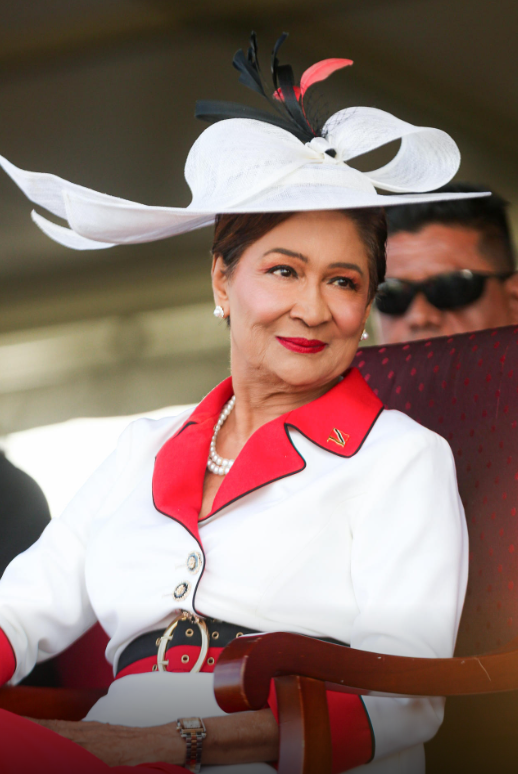
[Andrea De Silva, “Prime Minister Kamla Persad Bissessar at Trinidad and Tobago’s 64th Anniversary,“ 2026]
Haiti remains one of the most consequential expressions of this unfinished struggle for sovereignty. As the first independent Black republic, Haiti’s Declaration of Independence (1804) challenged the racial and imperial order of the Atlantic world. Yet independence did not secure the material conditions through which freedom could be sustained. The indemnity imposed by France, subsequent foreign intervention, economic coercion, political interference, and the destruction and reorganization of productive capacity repeatedly constrained Haitian sovereignty. From inception, it has been deprived of its sovereign rights, further undermined by a domestic bourgeoisie that serves contemporary “masters” of the Core Group, which are led by the United States, foreign military, and parastatal forces. [9] Haitian sovereignty may exist now only in name.
But there is another problem with the way we have imagined decolonization. Even our most powerful strands of anticolonial thought have often remained insufficiently attentive to land and ecological relations. This radical tradition broadly questions state power. It discusses who controls capital and production. It even has a clear understanding of epistemic dependence, as well as an understanding that political participation or access to the ballot does not guarantee that majority interests and needs will be met. However, we have been less astute at questioning our relations with land and nature. We have been less willing to ask how we belong to land or what obligations human communities have to the waters, forests, reefs, animals, and soils that sustain us.
What happens when we view land as a living relation and not a resource to be carved out and sold? This is where Indigenous Caribbean peoples, like the Kalinago and Garifuna, challenge the temporal assumptions of our decolonization. Too often, Indigenous peoples appear in Caribbean political thought as figures of the past: ancestors who were exterminated, populations who disappeared, or historical subjects who provide evidence of what colonialism decimated. But Indigenous Caribbean peoples are not historical relics. They are living in the present tense.
Their struggles over land, territory, water, community, and ecological relations continue today, and raise important questions about how life should be organized. [10] This may be one of the great blind spots in our project of epistemic decolonization. We have attempted to decolonize the archive without necessarily decolonizing our relation to land. We have learned to challenge colonial categories without challenging the assumption that nature exists primarily as an object of extraction and capital accumulation. We have attempted to reclaim Caribbean histories without fully restoring the relations between human communities and the living worlds that sustain us and make those histories possible. We have fallen into the "trap."
Material sovereignty remains the unfinished project of decolonization. Material sovereignty is not merely national ownership of resources. It is the collective capacity to secure and govern the material conditions of life: land, water, labor, food, energy, housing, ecological knowledge, infrastructure, and the means of social reproduction. Decolonization also requires another form of sovereignty: relational sovereignty. The story of slain, working-class Trinidadian fishers who routinely traveled to and from Venezuela—to fish and make a living less than seven miles away—is an ordinary aspect of our archipelagic material reality.
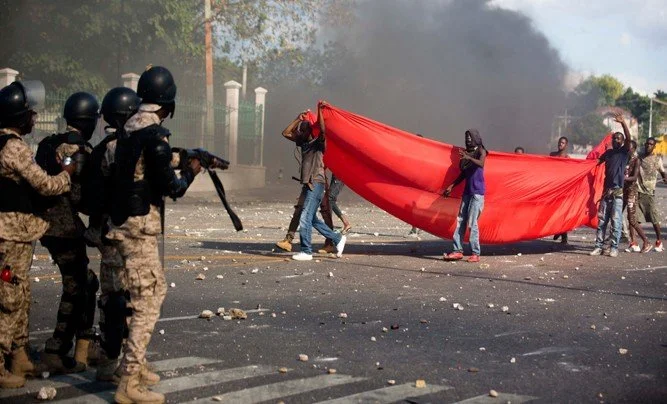
[Dieu-Nalio Chery, “Carrying a Haitian flag, protesters approach national police as the officers start firing at them, Port-au-Prince, Haiti,” 2019]
We know that no Caribbean island can reproduce itself on its own. Fish do not acknowledge maritime borders. Hurricanes do not stop at immigration checkpoints. Oil spills do not respect exclusive economic zones. Seeds travel. Currents flow. People move. Capital expands. Debt compounds. Military power lurks.
The Caribbean already lives relationally. Our sovereignty should also reflect this reality. This is why the defense of Barbuda's communal land is connected to Jamaicans’ fight to maintain public beaches, as it is to Tobago's struggle over its coast or its autonomy. Caribbean food insecurity is connected to plantation economies and import dependence. The vulnerability of Caribbean coastal communities to ecological disasters is connected to tourism, finance, climate change, and the ownership of land.
These are not identical struggles. They emerge from distinct histories, institutions, and relations of power. Their significance lies in how archipelagic thinking allows us to connect them without erasing those differences. Yet they express the unresolved question: who has the power to reproduce Caribbean life?
I argue that sovereignty reveals a network of capacities and infrastructures through which people sustain each other and attempt to govern the worlds upon which their survival depends. Archipelagic sovereignty requires the entire Caribbean to develop the capacity to collectively control, determine, govern, and transform the material conditions in which social and ecological life is reproduced.
Yet, such sovereignty cannot exist without an ecological ethic grounded in reciprocity. Perhaps this is the next stage of Caribbean decolonization: not simply to be “mimic men” or women, as V. S. Naipaul lamented, adorning the colonial “frump from Ascot” at our “Independence” Day gatherings. [11] The question remains: how do we assert our “archipelagic” capacity and material power to govern the conditions of life itself?
Caribbean communities have always lived within an archipelagic relation. Our task now is to build political, economic, and intellectual infrastructures adequate to realize our total liberation. The sea has connected us always, contrary to what colonial maps and categories depict. We must now organize to see what our waters have always known.
Notes
[1] For more information on the aftermath of the strike, see Ione Wells. “Families Sue US over Deadly Boat Strike off Venezuela Coast.” BBC. January 27, 2026.
[2] See Édouard Glissant. Poetics of Relation. Ann Arbor, MI: University of Michigan Press, 1997.
[3] See George Lamming. Sovereignty of the Imagination: Conversations III. Philipsburg, St. Martin: House of Nehesi, 2009.
[4] See Sylvia Wynter. “Unsettling the Coloniality of Being/Power/Truth/Freedom: Towards the Human, After Man, Its Overrepresentation—An Argument.” CR: The New Centennial Review 3:3 (2003): 257–337.
[5] See Lloyd Best. “Independent Thought and Caribbean Freedom.” Readings in the Political Economy of the Caribbean. Eds. Norman Girvan and Owen Jefferson. Kingston, Jamaica: New World Group, 1971 and Lloyd Best. “Outlines of a Model of Pure Plantation Economy.” Social and Economic Studies 17:3 (1968): 283–326.
[6] See Walter Rodney. How Europe Underdeveloped Africa. London: Verso Books, 2018.
[7] See Frantz Fanon. The Wretched of the Earth. New York: Grove Press, 1963.
[8] For the distinction between formal political independence and substantive freedom, see C. L. R. James. “Lecture on Federation (West Indies and British Guiana).” Argosy. June 1958.
[9] See Jemima Pierre. “Haiti as Empire’s Laboratory.” NACLA: Report on the Americas 55:3 (2023): 244–50.
[10] See Paula Prescod. The Carib, Kalinago, and Garifuna Peoples: Indigeneity, Hybridization, and Mobility in the Americas. Champaign, IL: University of Illinois Press, 2026.
[11] See V. S. Naipaul. The Mimic Men. Toronto: Knopf Canada, 2011.
References
Wynter, Sylvia and Katherine McKittrick. “Unparalleled Catastrophe for Our Species?: Or, to Give Humanness a Different Future: Conversations.” Sylvia Wynter: On Being Human as Praxis. Ed. Katherine McKittrick. Durham, NC: Duke University Press, 2015.
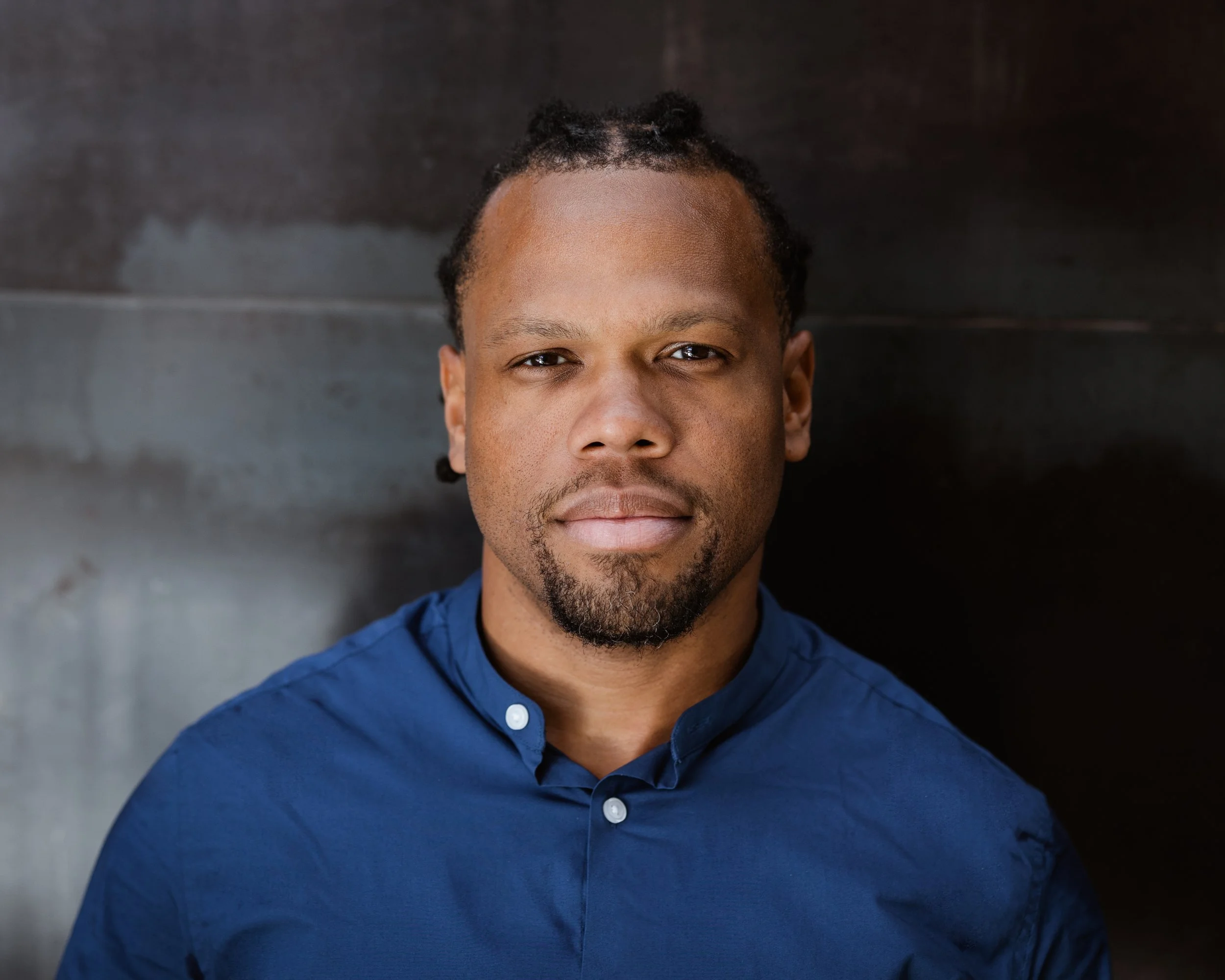
Dr. Keston K. Perry is an Assistant Professor in African American Studies at UCLA whose work examines Caribbean political economy, Black Studies, geography, environmental governance, and racial capitalism. His first book, Island Rebels on the Edge: Black Repair, Indigenous Survival and the Caribbean’s Struggle Against Ecological Imperialism (forthcoming with Columbia University Press), reframes Caribbean radicalism through Black and Indigenous struggles for sovereignty. His emerging projects explore Black queer coastal life, Caribbean belonging, material sovereignty, and community-governed ecological knowledge, including Unmaking Paradise and Cupecoy Shores.