Feeling Bitter in a Belated World

By Aisha P. L. Kadiri
I listen to German politicians talking about the rise of fascism in the United States, and I feel bitter. I hear a German friend talking about ICE but never about Frontex, and I feel bitter. [1] Where is this bitterness coming from? And what shall I do with it? The first question is easier to answer than the second. I am angry about the ease with which much of the German political landscape can condemn racial border regimes on one side of the Atlantic while washing its hands of its own participation in those same regimes on the other side. [2] I am angry about all the times that the term “fascism” has been labeled as the alarmist vocabulary of the “extreme left,” and the ease with which racialized people’s warnings have routinely been dismissed. And I am angry about how much all of this is part of broader German political imagination, how structures only seem to become legible in delayed and partial ways. Accompanying this anger is a sense of bitterness that our history could have been otherwise.
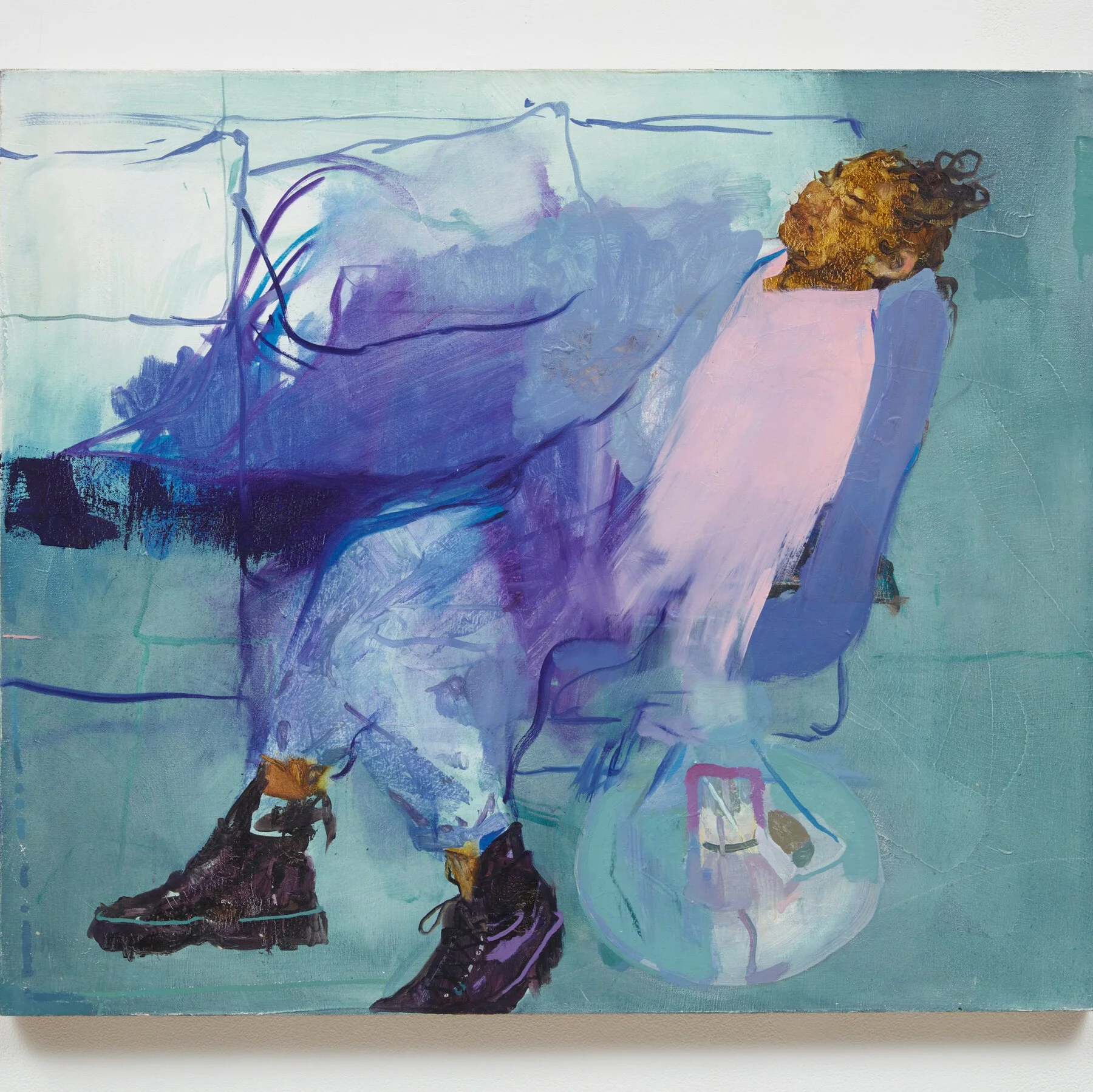
[Jennifer Packer, “Melt,” 2025]
What to do with that bitterness? A quick internet search will give me countless concrete steps on how to prevent oneself from becoming a “bitter person.” But what is “bitter” about bitterness? Katie Stockdale, in “Losing Hope: Injustice and Moral Bitterness,” writes that bitterness is “a moral emotion, that is, an emotional response to perceived moral failures in the form of actions, omissions, practices, and policies that are within the power of human moral agents” (365). Bitterness for myself is not so much a prolonged feeling as a temporary sensation, mixed with other feelings, such as anger and sadness. Sometimes, it takes months before it suddenly rears its ugly head again. My political mind tells me bitterness has no place in political coalitions. We need to have as many people on board as possible, no matter how long it took them to be in solidarity, or how far away they were beforehand. Here, bitterness is unproductive. But no matter how much I try to tell myself that, I suspect not all feelings of bitterness are unproductive. Not all bitterness should be immediately discarded, hidden, or treated in therapy.
Resentment, Entitlement, and Ignorance
Bitterness is often linked to resentment, which, in turn, can be linked to entitlement. If resentment has a slightly negative connotation—of not being able to move on after an injustice—then this slight undertone becomes overt negativity in the case of entitlement. An entitled person thus makes demands, and usually unjustly so when saying, “I am entitled to my opinion.” This signals a refusal to earnestly engage with new evidence and different opinions, resulting in an ignorant posture. Being regularly confronted with ignorance can make oneself bitter, but bitterness can also come about from spouting ignorance and being met with a lack of understanding. But ignorance is here implied to lie with the one uttering “I am entitled to my opinion”—such as the caricatured flat earther, the climate change denier, or the avowed racist—and not the audience of the utterance. What if the case were reversed, and if the insistence to know better stems not from ignorance but rather stands to counter it?
In “Global White Ignorance,” the Caribbean-American philosopher Charles W. Mills describes “white ignorance” “as a particular optic, prism of perception and interpretation, a worldview” (218), which denies racial domination and its systemic character, thereby upholding white supremacy. The term entitlement can encompass the maintenance of white ignorance as well as the insistence on the lived experience that I know and feel in my bones, but that gets disavowed by others. To this epistemic denial, one may easily say, “I am entitled to my lived experience.” Here, entitlement also comes into play. However, describing both these responses as entitlement does not mean equating them. These positions are not supported in an equal manner by socio-political and economic structures. While some find their claims dismissed and are characterized as bitter—stuck in the past, and unable to move on—others are told their resentment is valid. Resentments are given material weight. Privileges, no matter how unjustly accrued, are constructed as legitimate entitlements to have. White ignorance is thus instrumental for the material conditions of white supremacy and racial capitalism.
On Feeling Too Late and Too Early
If bitterness is preceded by not moving on—in other words, if the refusal to move on makes bitterness possible—then this refusal is an act of entitlement. An entitlement that is informed by one’s own lived reality, everyday encounters, news from family in close and distant places, and the refusal to close one’s eyes to the downtrodden, the wretched. It is precisely this refusal to move on that lays bare structures of white ignorance and can manifest as a feeling of having been “too early.” In important ways, this experience of being too early relates to the Martinican, anti-colonial psychiatrist Frantz Fanon’s notion of being too late in Black Skin, White Masks. He writes: “Too late. Everything had been predicted, discovered, proved, and exploited. My shaky hands grasped at nothing; the resources had been exhausted. Too late! But there again I want to know why” (86).
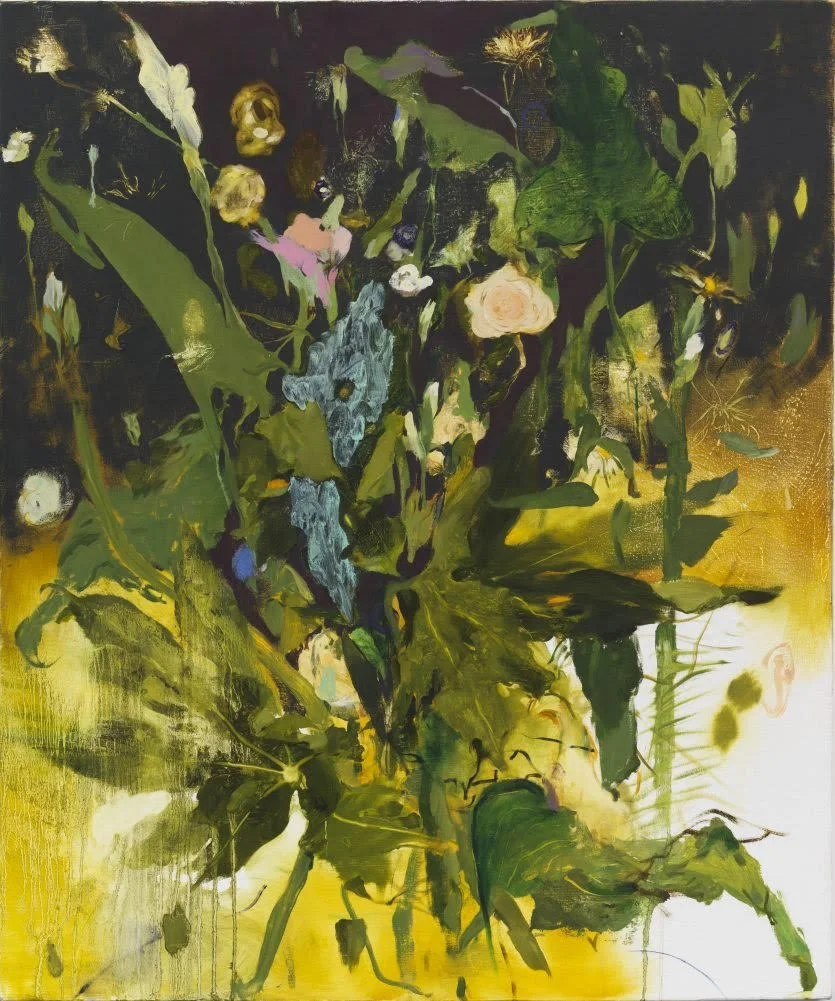
[Jennifer Packer, “Say Her Name,” 2017]
Fanon encounters a world that already has all the knowledge, and whose knowledge assigns him a specific place in this already explained world. That is to say, a place in its racial hierarchy, which he is seemingly unable to escape. It is a world that is simultaneously beyond reach and oppressively close, restricting his movements and ability to create meaning. This is an experience that Alia Al-Saji succinctly describes in “Too Late: Racialized Time and the Closure of the Past,” as “racialized time,” a perpetual lateness to the world, which has already been defined and thereby robbed of possibilities. For Fanon, this leads to disorientation, nausea even. [3]
I think this embodied experience of racialized time, of being too late, bears resemblance to the bitter feeling of being too early. Being too late is an artificially created mirage of missed opportunities and shrunken horizon of possibility. And being too early just means being unseen through the prism of white ignorance. In both instances, one’s own knowledge does not correspond to the dominant episteme. Being too early and being too late are then two different encounters with white ignorance, two sides of the same coin of embodied racialized time. And both are inherently linked to the power to determine who knows, what is known, and what is knowable. [4] These modalities are felt encounters with socio-political structures. The lived experiences of these temporal configurations are fundamentally asynchronous, that are not only felt individually but also often shared collectively. [5]
I come back to my question: What to do with this bitterness? I suspect the answer ought to address the socio-political aspect of lived temporality in unjust times. It is not so much about being right, or about always having known. After all, I can be “too early” in some regards, while having been unforgivably ignorant in others. My feeling of being “too late” to the world does not preclude that I, perhaps unknowingly, participate in the construction of someone else’s lateness. Most of us inhabit many of these positions simultaneously with regard to the structures of power that we are embroiled in. [6] The question of how to address this in our socio-political practices means also addressing the relations that feeling “too late” and “too early” are wrapped up in. We need practices that allow us to acknowledge this temporal lived experience of untimeliness—the cumulative resentment and fleeting feelings of bitterness—without letting these experiences close down solidarity, shared struggle, and shared understanding.
I began this text with a feeling of bitterness that neither self-help nor therapy can eradicate. A feeling that can flare up in reading a news story, or in a conversation, and whose fleeting nature does not correspond to the hardened cynicism or even misanthropy that is often implied in the sentence, “She has become a bitter person.” Bitterness need not be a hindrance to coalitional political activity, but rather a cautious guide through its difficult terrain, for at least three reasons. First, it is an embodied reaction to the ever-shifting borders of white ignorance, urging us to consider preconditions for shared struggle, and allowing us to draw and redraw lines in the coalitional sand. Second, these fleeting feelings of bitterness reveal the differential experience of racialized time, which once understood can also allow to eventually build bridges across these temporal differences. And third, the tenderness needed to let bitterness come and go itself constitutes a necessary practice. [7] One that Al-Saji, in “Touching the Wounds of Colonial Duration,” calls touching “the wounds of racialization” (6). To be a “bitter person” means not only being entangled with feelings of resentment and hints of entitlement. [8] Our bitterness is also capable of affectively changing the racial hierarchies of this world.
Notes
[1] ICE is the United States Immigration and Customs Enforcement, and Frontex is the European Agency for the Management of Operational Cooperation at the External Borders.
[2] Importantly, Frontex operates in the Mediterranean, as well as other regions, such as the Belarus-EU border.
[3] I am thinking here of a distinctly Fanonian “Black nausea,” one that Corey Reed describes as “the psychological moments where one becomes aware, or is reminded, of their Blackness in an anti-Black world, and finds existential and phenomenological tension regarding their freedom” (141). See Corey Reed. “Black Nausea: Existential Awareness of Antiblack Racism and a Phenomenology of Caution.” Critical Philosophy of Race 13:1 (2025): 139-156.
[4] I believe this is also where the concept of epistemic injustice is particularly relevant. For a critical contextualization, see Sarah Bufkin. “Racism, Epistemic Injustice, and Ideology Critique.” Philosophy & Social Criticism 52:1 (2026): 34-58.
[5] On the shared temporality of racialized time, see also Habiba Ibrahim and Badia Ahed. “Introduction: Black Temporality in Times of Crisis.” South Atlantic Quarterly 121:1 (2022): 1-10. In this work, the authors explores how various times (e.g., historical, quotidian, and contemporary time) are made sense of collectively, as well as how “[d]isengagement from ‘clock time’ is a counter-nationalist (feminist) temporality that reemerges in the present as newly imagined Black futures” (9).
[6] On the potential pitfalls of standpoint epistemology, see Olúfémi O. Táíwò. “Being-In-The-Room Privilege: Elite Capture and Epistemic Deference.” The Philosopher 108:4 (2020): 61-70.
[7] Elizabeth Paquette, in “A Tenderness Approach to Philosophy,” conceptualizes “tenderness as devotion of time and concentration, as directional, relational, and embodied” (99). Under racialized time, tenderness can be imagined as a practice of care and attention given to one’s own and others’ experience of bitterness. This is an acknowledgement of bitterness’ existence and its non-linearity in the experience of oppression. Such tender practice of care also relates to what Al-Saji describes as a form of “dwelling,” as the refusal to move on in racialized time. See Elizabeth Paquette. “A Tenderness Approach to Philosophy.” American Association of Philosophy Teachers Studies in Pedagogy 7 (2022): 99-117.
[8] This bitterness bears a resemblance to Sara Ahmed’s concept of being a “feminist killjoy,” one who refuses to quietly accept sexism. Similarly, I argue that bitterness can be used to disrupt the smooth running of racialized time, making it both explicit and uncomfortable for those stuck in white ignorance. See Sara Ahmed. The Feminist Killjoy Handbook: The Radical Potential of Getting in the Way. New York: Seal Press, 2023.
References
Al-Saji, Alia. “Too Late: Racialized Time and the Closure of the Past.” Insights 6.5 (2013): 1-13.
"Al-Saji, Alia. “Touching the Wounds of Colonial Duration: Fanon's Anticolonial Critical Phenomenology." The Southern Journal of Philosophy 62:1 (2024): 2-23.
Fanon, Frantz. Black Skin, White Masks. Trans. Richard Philcox. Penguin Books, 2021.
Mills, Charles W. “Global white ignorance.” Routledge International Handbook of Ignorance Studies. Eds. Matthias Gross and Linsey McGoey. London: Routledge, 2015.
Stockdale, Katie. “Losing Hope: Injustice and Moral Bitterness.” Hypatia 32:2 (2017): 363-379.

Dr. Aisha P. L. Kadiri received her PhD in philosophy from the École Normale Supérieure (PSL) in Paris with a thesis on digital colonialism and Frantz Fanon. Her work focuses on our interaction with technology in a world marked by inequalities, with a particular focus on alienation, data privacy, and planetary change.