Tragedy and Speculation in Honduras

By José Enrique Hasemann Lara
Between April and July 2022, I carried out exploratory research on Próspera ZEDE (Próspera), a Honduran special economic zone. [1] ZEDEs (Zones for Employment and Economic Development) are special economic zones that grant incorporated entities an unprecedented degree of autonomy from the central government through the implementation of legal frameworks known as charters. Each ZEDE charter is developed independently according to each ZEDE’s envisioned needs. [2]
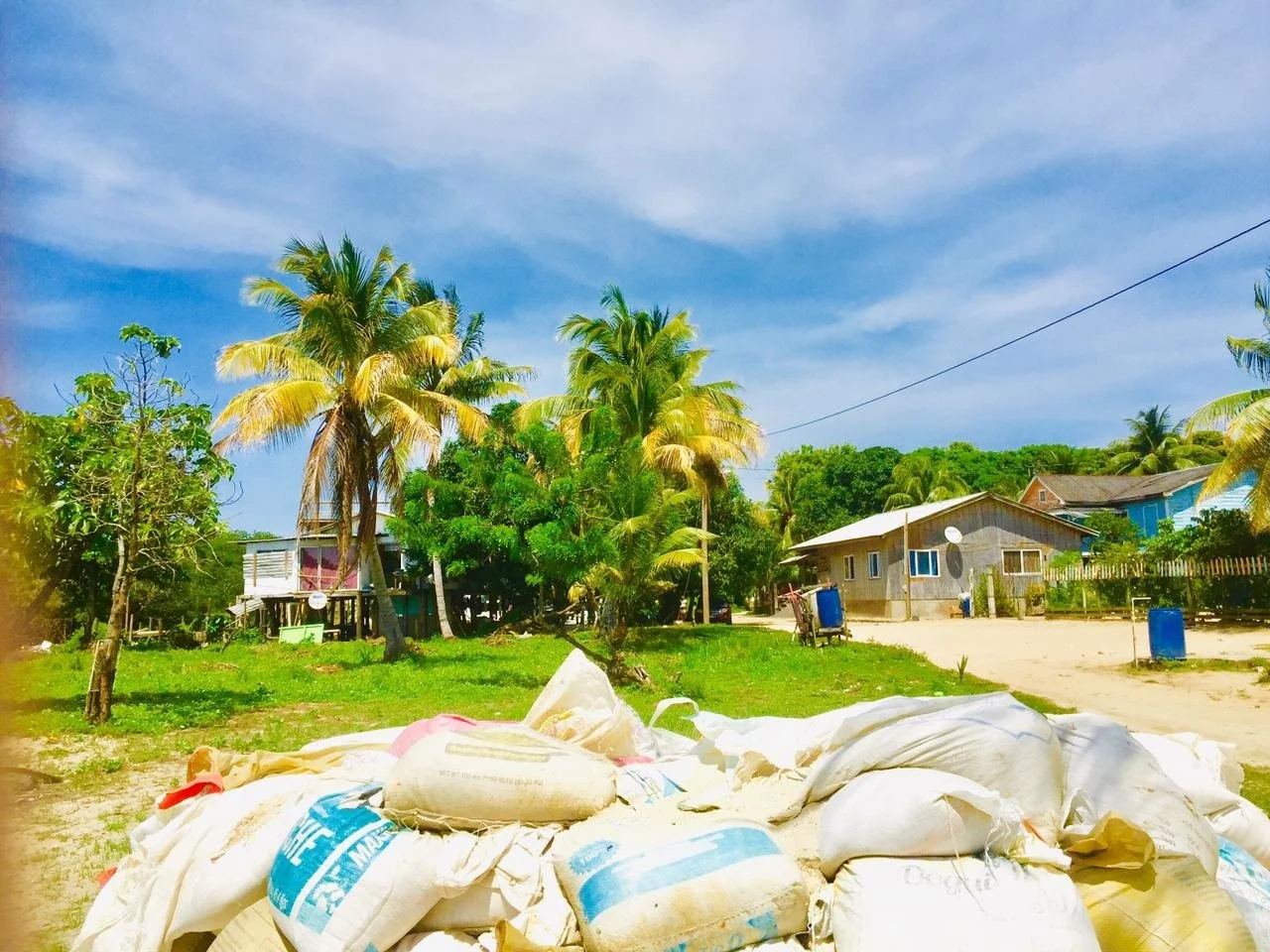
[Sherina Webster, “Tropical Stillness,” 2022]
In 2020, Próspera began operations on the island of Roatán, which lies off the North coast of Honduras, next to Crawfish Rock (Crawfish), a village predominantly settled by Black English-speaking Peoples (a Honduran ethnic group). Local tensions and disputes simmered as Próspera cajoled Crawfish residents that were more sympathetic to support the project. [3] Others, like Venessa Cárdenas and Luisa Connor, college graduates and schoolteachers in their early forties, were certain that Próspera had settled next to Crawfish because poor local infrastructural development would it make it easier and cheaper for Próspera to acquire more land for future expansion. The same factor that led to the earlier establishment of two neighboring tourism developments, Pristine Bay and Palmetto Bay.
Writing about a similar project in southern Honduras, Bridget Martin and Beth Geglia argued in “Korean tigers in Honduras” that ZEDEs are speculative projects structured around spectacle and erasure. Spectacle promotes grand visions of a future that never materializes, while erasure uses “maps and plans” to obscure “local conditions” (8). Both are necessary to secure access to land. Building from their account, I argue that there is a second level of erasure taking place between Próspera and Crawfish: namely, the obliteration of Crawfish residents’ lived-experience as a marginalized minority. This second erasure serves to discredit local opposition to ZEDEs by turning skeptics into non-credible narrators. In what follows, I draw from my field notes to depict some of the experiences that textured some Crawfish residents’ responses to Próspera.
More of the Same for Crawfish Rock
16 May 2022: I spent part of my afternoon chatting with folks in Crawfish. Ernesto, a young man in his mid-twenties, pointed out that local freedom of movement was probably the thing most affected with Próspera’s arrival. Like others, however, he also noted that freedom of movement through the hills and the beachfront was impacted long before the ZEDE, because of Palmetto and Pristine Bay. Ernesto admitted that many in Crawfish continued to hunt on the surrounding private property, but owners and developers were adopting more drastic measures to curtail incursions. Sebastian, a fisherman in his early 70s, shared how he had suffered the same problem back in the 1980s, when a private conservation institute managed by a local diving resort began patrolling his fishing spots and preventing his fishing activities. [4] Ironically, these patrols forced Sebastian to fish quickly and stealthily, resulting in him being less discriminating about the fish he caught.
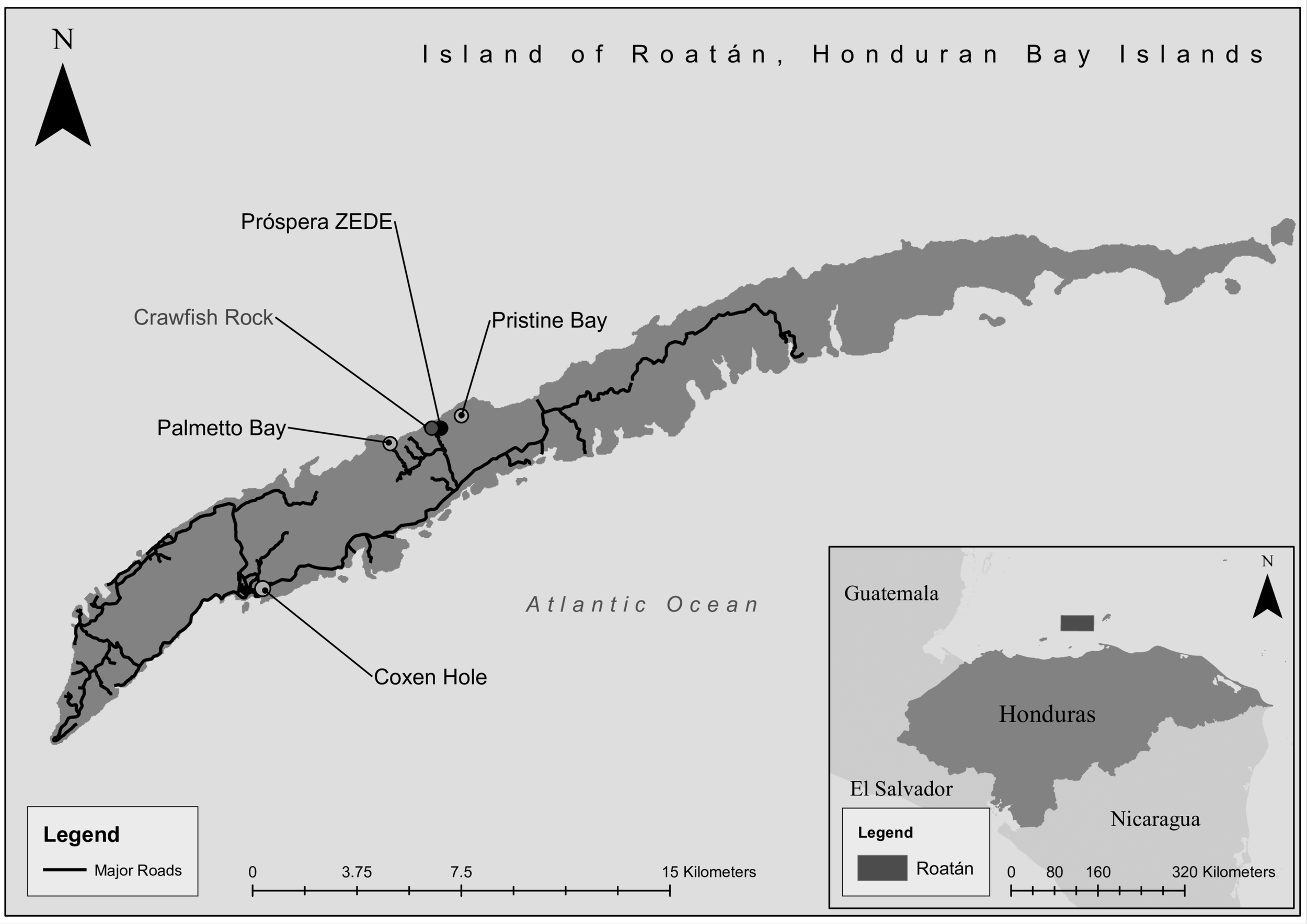
[José E. Hasemann Lara, “Map of Crawfish Rock in Relation to Other Local Landmarks,” 2025]
We also discussed Próspera’s construction projects, particularly the initial stages of a mixed-use residential tower, and how Próspera had leveled a hill and possibly choked two nearby seasonal freshwater streams. Ernesto also argued that such a fate was probably planned for Crawfish: push everyone out, tear down all the houses, and build residential complexes with seaside views and a “tennis court for Americans.” I assumed Ernesto’s comments were speculative, but I had to re-evaluate this position a couple of days later after driving to the Pristine Bay Beach Club.
18 May 2022: As I made my way to the beach club, I had to drive through Pristine Bay, which occupied a series of hills in front of a small bay. Unlike the hills around Crawfish, the hills inside Pristine Bay had been cleared to make way for palm trees and verdant lawns. After driving past the main gate, I drove up a hill for about 100 meters. At the top, I was able to appreciate Pristine Bay’s footprint which stretched from the beach to the bay about 1 kilometer away. As I made my way down the hill, through a long and winding road, I was surrounded by lush green lawns at every turn. It took me a while to realize I was driving through a golf course. That’s also when I understood Ernesto’s premonition.
After driving through Pristine Bay’s complex, it was not difficult to appreciate what Ernesto had visualized when anticipating future Próspera developments. After all, Próspera had recently acquired the Pristine Bay Beach Club and was also beginning its own intensive construction projects. At that moment, there was little that was speculative about the potential danger represented by Próspera and the local concern it was generating. For example, two weeks earlier, Malcolm, another Crawfish resident in his late fifties, took me around Próspera’s perimeter only to point out devastating acts of deforestation, with earthworks already affecting the landscape. [5]
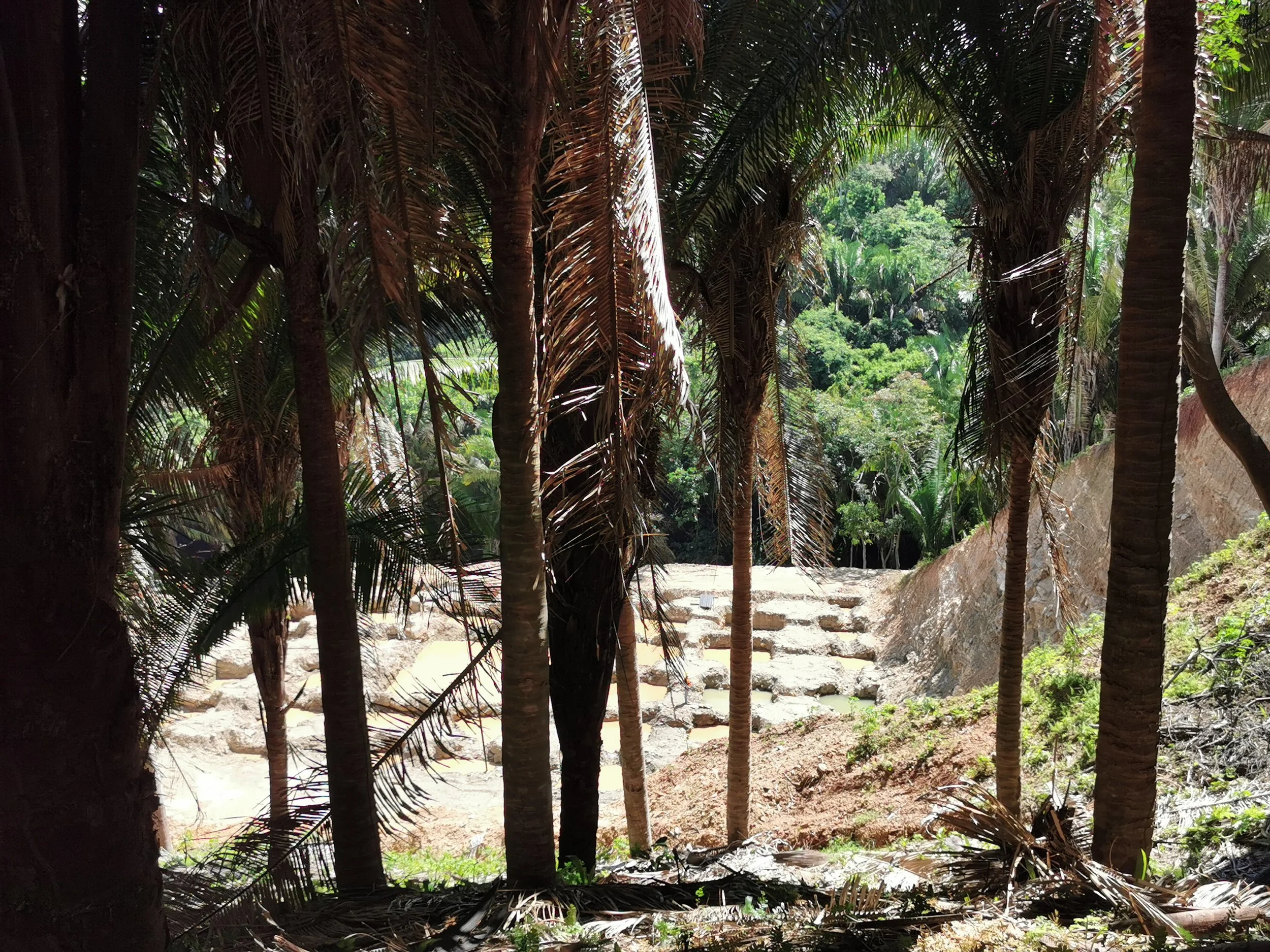
[José E. Hasemann Lara, “Initial Stages of Construction for Próspera’s Mixed-Use Tower (view from the road),” 2022]
Tragedy and Non-Speculative Futures
In early April 2026, Próspera organized a tourism forum on Roatán that included a mix of private and public entities. [6] One of Próspera’s CEO’s short-term appraisals was that Roatán still lacked “basic tourism infrastructure. More rooms, more hotel accommodations, that’s the essential condition.” When thinking about how Ernesto’s or Malcolm’s evaluations had little resonance beyond Crawfish, the word tragedy pops into my head. I am particularly drawn to Michel-Rolph Trouillot’s “Anthropology and the Savage Slot: The Poetics and Politics of Otherness.” While Trouillot did not explicitly write about tragedy, we can draw out such elements by thinking through Lewis Gordon’s approach to the concept in Fanon and the Crisis of European Man. For Gordon, tragedy starts with an expectation that is contrary to reality, within which an action takes place, and for which some reckoning is inescapable (71-75). The contrary expectation, in Gordon’s case, is that one’s position or intent should grant one the privilege of eschewing justice.
Importantly, in “Anthropology and the Savage Slot,” I find two contrary expectations from Trouillot. The first lies in assuming knowledge, without the work of critically evaluating one’s place in the world, is enough to effect change. The second contrary expectation lay in hoping that others, when confronted with evidence of how we inhabit “inherited fields of significance” (18), will be able to appreciate how some consequences can be reliably anticipated without resorting to speculation. While some tragedies occur due to individuals committing actions irresponsibly, Trouillot also lays responsibility on an Other that is unwilling or incapable of acknowledging the acting party.
In other words, Próspera (and other agents in concert with Próspera) may be unwilling or incapable of acknowledging the evidence offered by Malcolm and Ernesto because they do not share the necessary frame to appreciate the significance of evidence or are simply indifferent to the gravity of the situation. For Crawfish, the tragedy is in part due to Próspera dismissing Crawfish residents’ opposition (and the evidence of their lives) to satisfy the (inherently uncertain) pursuit of future accumulation. [7]
In “Speculation,” Laura Bear argues that creating value in the future (i.e., speculation) requires devaluing specific populations in the present by capitalizing on uncertainty. The trick is to present some populations as obstacles to capital accumulation (e.g., the poor) and others as capable of navigating the uncertainty presented by said obstacles (e.g., entrepreneurs). However, some Crawfish residents shared a view of the future that hinged on certainty, on knowing that there will be some continuation between their past and their future. For Luisa, it was also clear that this continuation was both systematic and founded on the racist precept that “those dumb black people, there in the bush, they don’t even know what they have,” and, by extension, any idea of how to develop it. [8]
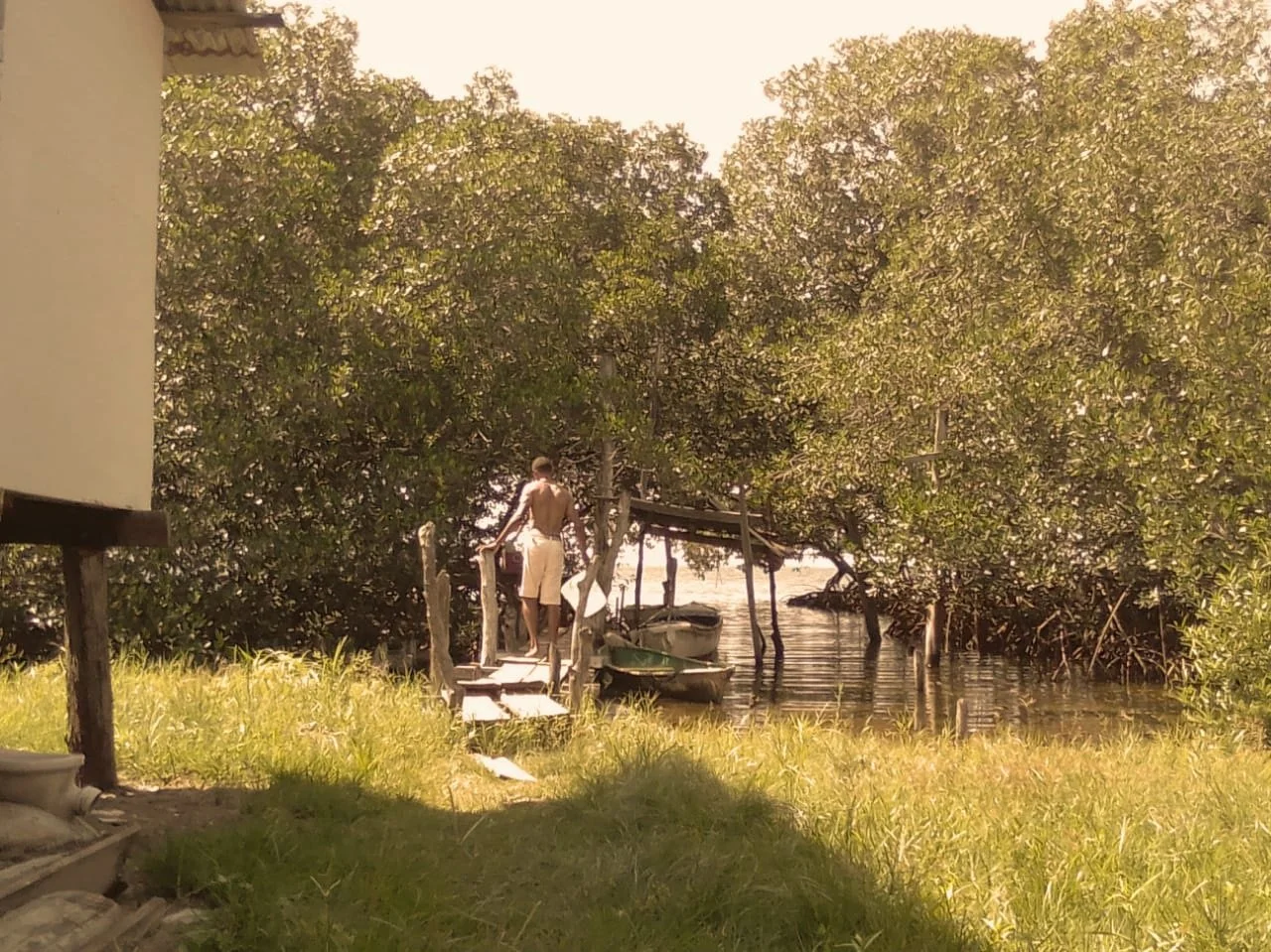
[Ángel Bodden, “The Quiet Departure at the Old Dock, Mangrove Sanctuary,” 2022]
Brenda, for example, a Crawfish resident in her early thirties, knew that developers always found ways to skirt local laws and that laws were not equally enforced. As an habitual fisherwoman, Brenda was mostly preoccupied with environmental regulations, noting how large commercial fishing operations were allowed to fish directly on the coral reefs, while small independent fishers had to be overly cautious about size requirements; or how people in Crawfish could not even cut down a tree without getting a permit, but Pristine Bay had turned the hills “into a dessert by building that golf course.” However, environmental regulations were not the only persistent concern among residents.
Melinda, a Crawfish resident in her mid-thirties, was concerned that over the last 10 years some people in Crawfish had lost legal ownership over their property after external actors had taken advantage of the poorly maintained land registration system on Roatán to register local properties under different owners. [9] Melinda also thought this practice had intensified around 2013 with the burgeoning promise of ZEDE developments on Roatán.
Brenda was certain that Crawfish Rock village would disappear in the near future. Residents were feeling the pressures of living in an isolated area with increasingly hampered access to non-wage labor subsistence strategies (e.g., fishing, hunting, crab collecting, cashew nut farming and processing). Likewise, Luisa and Venessa were certain that Crawfish was at a disadvantage when negotiating with Próspera, since Crawfish did not have the same social, cultural, or economic capital to mobilize support as effectively.
Ultimately, Crawfish residents were certain of what lay ahead because they were certain of both the factors that conditioned their daily lives and the continual changes in their material conditions as new development projects took shape near them. Let us not commit more tragedies by devaluing how these communities are navigating and fighting for their future under no uncertain terms.
Notes
To read the Spanish translation of this blog post, please visit this link (“Tragedia y Especulación en Honduras”).
[1] For methodology, see José Enrique Hasemann Lara. "Competing ideas of the human and the constitution of private cities in Honduras." Etnografica (Forthcoming).
[2] For a description of the origin, development, and potential consequences of the charter model adopted by ZEDEs, see Andrea Nuila Herrmannsdörfer. “What is the right to land in the age of private jurisdictions?” FIAN International (2022): 1-10. For an exploration of the relationship between ZEDEs, the Honduran government, and transnational interests, see Martin and Geglia (2019).
[3] Interview: 03 April 2022, Venessa Cárdenas and Luisa Connor. Both individuals gave permission to use their real names; pseudonyms are used for all others mentioned.
[4] For Hanna Siurua, “conservation schemes…are inherently political” processes resulting in the “redistribution of resources…shaped by…power, wealth, and influence” (86). For more information on conservation policies, see Hanna Siurua. "Nature above People: Rolston and ‘Fortress’ Conservation in the South." Ethics and the Environment 11:1 (2006): 72-96.
[5] Interview: 02 May 2022.
[6] For more information on the tourism forum, see Próspera Connect. "Honduras Próspera Inc, COHEP, CANATURH y Senprende trazan juntos el futuro del turismo en Roatán." Próspera Connect, April 13, 2026.
[7] See José Enrique Hasemann Lara. "La elaboración de jerarquías de lo humano mediante la especulación: Las ZEDES como extensiones del orden colonial bajo el capitalismo." CRIA Working Papers 24 (2023): 1-17.
[8] Interview: 25 May 2022. For more on racism and development, see Charles W. Mills. "The chronopolitics of racial time." Time & Society 29:2 (2020): 297-317.
[9] Interview: 28 April 2022.
Funding Statement: Research was made possible through a postdoctoral fellowship from the Fritz-Thyssen Stiftung (Ref. 40.21.0.041EL).
References
Bear, Laura. "Speculation: a political economy of technologies of imagination." Economy and Society 49:1 (2020): 1-16.
Gordon, Lewis. Fanon and the Crisis of European Man: An Essay on Philosophy and the Human Sciences. London: Routledge, 1995.
Martin, Bridget and Beth Geglia. "Korean tigers in Honduras: Urban economic zones as spatial ideology in international policy transfer networks." Political Geography 74 (2019): 1-12.
Trouillot, Michel-Rolph. "Anthropology and the Savage Slot: The Poetics and Politics of Otherness." In Recapturing Anthropology: Working in the Present. Ed., Richard G. Fox. Santa Fe, New Mexico: SAR Press, 1991: 17-44.

Dr. José Enrique Hasemann Lara is a cultural anthropologist with a Ph.D. from the University of Connecticut (2021), and an MA (2011) and an MPH (2011) from the University of South Florida. His ongoing research focuses on racialization, speculation, constructions of the future, and distribution of and access to public goods in Honduras. José Enrique is currently an associated researcher with the Honduran National Autonomous University (Tegucigalpa, Honduras) and Iscte-CRIA (Lisbon, Portugal).