The Puissance of Word-Weaving: Singing “Bastard” into “Batarsité”

By Mary Gregg + Mathilde Turpin
In 1994, Danyèl Waro published “Batarsité.” This song would not only come to define the unique mix of the Reunionese people but would act as a cornerstone of pride and identity in La Réunion. However, Batarsité is not simply a concept that emerged from Waro’s song; it is an omnipresent philosophy of existence shaped by the island’s unique history of mixing. As Waro notes in a 2024 interview, “I did not make the concept, I put a word on it.”
Importantly, the term “Batarsité” stems in part from the French slur “bastard.” Yet, the people targeted by such harmful speech have reclaimed their power by redefining the source of harm and its implications on their own terms. In this sense, Batarsité directly redefines and changes the aims and implications of the term "bastard" as it does not respond to the slur in the oppressor’s language, but by the terms of the in the victim’s own reality and language. More than softening harm, it reorders the terms of recognition for the Reunionese.
History of the term “Batard” in the context of La Réunion
La Réunion is a small island in the Southeast of Madagascar. It has been a French region since 1982; and was a French colony for centuries until 1946 when it became a French department. If most people ignore this fact, it is not only due to bad luck or small geographic territory; French people, from the mainland, have traditionally ignored the Reunionese people, though they hold the exact same passport and nationality. [1]
The French slur “batard” belongs to the category of what some theorists have termed “toxic speech.” [2] The use of this slur on the Reunionese population reflects deeply rooted hatred and condescending attitudes towards the Reunionese from the mainland French. On the Reunionese side, the slur operated as a tool of self-hatred which sustained the idea of a social hierarchy between “inferior” Reunionese “bastards” and the “pure mainland French.” For instance, a Creole from La Réunion is always deemed to be inferior, notably because he is viewed as a “bastard” (Waro, 2024). Indeed, with centuries of slavery and immigration from all over the world, the population in La Réunion is heavily creolized or racially mixed.
Waro’s Remixing Model
So, how, if at all, can such derogation be combated? One such avenue is counterspeech which has become a popular method for combating derogatory terms and hate speech more broadly. Denials, direct challenges, “bending,” and “rephrasing” have all been discussed as means of combating hate speech by some form of denial or softening their affective blow (if not removing, then reducing, its semantic power). [3] However, such counterspeech attempts do not always address the victim’s ability to completely suppress, recraft, or reappropriate the harmful speech.
Danyèl Waro’s concept of “Batarsité” addresses this issue, as he goes beyond mere negation of derogatory speech. Through the conversion of the derogatory term “batard” into Creole, Waro changes the term’s aim and meaning. This is in part because the Reunionese are represented as no longer victims to be “narrated” but rather are narrators of their own cultural identity. Thus, while Bianca Cepollaro, Maxime Lepoutre, and Robert Mark Simpson, in “Counterspeech,” may argue that “counterspeech is communication that seeks to counteract the potential harm that is brought about by other speech,” this does not mean that such harm cannot be eliminated (2). Waro’s Batarsité does not simply remove but replaces the harmful meaning of the term.
This account of Waro’s work then is not merely an exegesis of his impact on the Reunionese community, but an explanation of the function and broader implications of the reclamation of a derogatory term. In particular, it reveals how derogatory terms may not only be successfully blocked but reclaimed by those they were created to harm. Waro’s “Batarsité” album delves into the Reunionese culture, history, and society while highlighting the French government’s contempt. As Maloya music was censored until 1981, and remained taboo long after, it links to Réunion’s past of colonization, slavery, poverty, and oppression. [4] This term also reproduced colonial power and discrimination beyond institutions through the language that organizes recognition and meaning of the Reunionese appearance and identity. Today, the song and album “batarsité” are an integrated part of Reunionese culture and folklore.
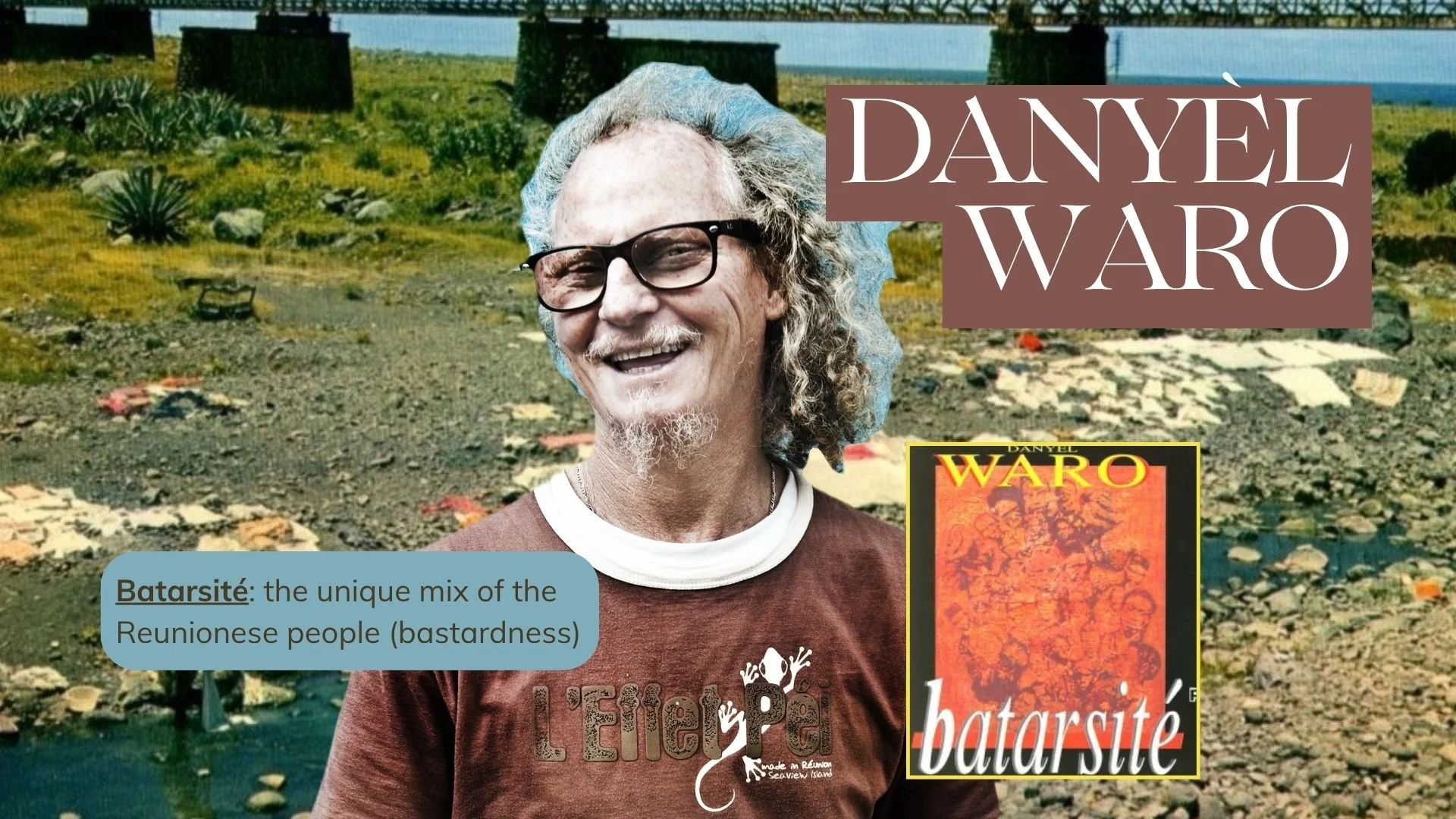
[Mathilde Emma Turpin, “Nout Batarsité,” 2026]
The title song’s opening denounces the Eurocentric binary views of ethnicity and identity as “black” or “white.” In six minutes, Waro proudly asserts the high level of mixing and diversity that makes the Reunionese unique and culturally “overflowing.” Throughout these verses, he encourages the Reunionese to embrace their background and understand the power of their values. The song “batarsité” is now more than a simple song for the Reunionese, the term defines the unique mix of the Reunionese people; whether it is ethnic, cultural, historical, musical, etc. In other words, Waro ambitiously rebranded the French slur “bastard” to establish this diversity as a force. In an “Interview on Batarsité,” he defines the term as follows:
We don’t have the good color, the true color, the true religion. We don’t have our original language, nothing of origin in reality, and we made our own thing. That’s what makes “batarsité”, and “bastardness”. But in Creole when someone says a “batar sinwa, batar zarab, batar komor, batar yab, batar malbar,” he means the mixing [...] I take the word “bastard” to ask questions, to seek who we really are, and to take off the shame, taboo, and awkwardness of people. We have reached such a point in our mixing, in the “batarsité”. But our conscience is a bit behind. So when I sing Batarsité it’s to say “Guys, we’re already far, we made a great wealth.” We’re a person, we’re not a semi-person or some failed mixture (4).
Hence, “batarsité” exists as a concept defining and inspiring the Reunionese to use their culture and promote acceptance, pride in diversity, and the possibility of a peaceful cooperation of all origins. Through the song Batarsité, Waro bypassed the French slur “batard” by not only translating it to Creole but converting it to an identity-affirming concept. The significance of translating the derogatory term into Creole has historical and revolutionary significance.
At the time of Reunion’s colonization and even today, Creole has been a language which was at first forbidden and is even now described (by teachers) as a language that marks one out as “uneducated.” Translation of the term from French into Creole—from the language of the oppressor to the language of the people—is itself a move from one language game to another, where linguistic power lies in the refusal to engage in colonized speech. Lewis R. Gordon speaks on this in his work, “Disciplinary Decadence,” where he states:
That modes of producing knowledge can be enlisted in the service of colonisation is evident. Frantz Fanon, for instance, reflected, in Peau noire, masques blancs, that methods have a way of devouring themselves. In doing so, he brought into focus the problem of evaluating method itself, of assessing methodology. If the epistemic conditions of social life were colonised, would not that infection reach also the grammatical level, the very grounds of knowledge? Put differently, couldn’t there also be colonisation at the methodological level? If so, then, any presumed method, especially from a subject living within a colonised framework, could generate continued colonisation (85; emphasis added).
At the grammatical level, the term “batard” was infected with colonial abuse. However, here, by revoking the very language in which the term of derogation has been spoken—removing its French contextualization by reclaiming it as a Creole term—Waro shifted the grounds on which Reunionese people could be understood. Instead of being viewed pejoratively or through the lens of illegitimacy, “batarsité” is assigned a different meaning. In fact, testimonies reveal that some Reunionese identify with the term, but without said violence. [5] But the term does not stop at mere linguistic recontextualization. Knowing how to speak Creole is one thing, mastering the Creole language, to the point of reconfiguring it, is quite another. While the chess novice only plays by the rules of the game, the chess master plays by creatively breaking the rules of the game. This is also true of language games.
Waro is not merely fluent in Creole but is taken by the Reunionese community to be in a position of linguistic authority amongst Reunionese Creoles because of his identity and deep familiarity (firsthand and historical) with both the term's use and harms. He knows the term as both one who was impacted by its pejorative usage but also as someone who knows the history, function, and impact the term has had on Reunionese identity, culture, and people. In other words, by the norms and entitlement conditions of the linguistic community, Waro is entitled to not merely criticize or translate the term but to reimagine it as a badge of pride and honor.
In its reimagining, Waro and the Reunionese insist that “batarsité” is a “state of mind” promoting acceptance of Creole identity not just locally but globally. Danyèl Waro himself claimed that "batarsité" is based on faith in humanity: he wishes that people focus on human values in any situation and question the forces that drive division, violence, and hatred.
In emphasizing the importance of empathy, the term also makes a claim not to originality or purity, but to the inventiveness of humanity where all people are self-made. "Batarsité" hence applies globally as a philosophy of humanity more than simply referring to the Reunionese population. Batarsité includes a broader claim that as humans—regardless of religion, ethnic background, language, hair, etc. (as per the song’s lyrics and the 2024 Waro interview)—we must cooperate and care for each other.
No person on this planet is “pure” in the colonized sense of the term. We each carry a mix of cultures, ethnicities, opinions, and personalities, so the claim that one can be “pure” is invalidated by Batarsité, a term which shows that purity is not only unachievable but undesirable. [6] This is not to say that the term itself can be used by and applied directly to populations outside of La Réunion, as the term implies that one’s identity is Reunionese Creole. Rather, the point is that the term makes a broader comment about (and philosophy of) humanity in its invitation to reconceptualize Creole identity and its unique way of putting pressure on racialized boundary policing.
Importantly, in an “Interview on Batarsité,” Waro expressed that “batarsité" is “(their) Reunioneseness, (he) didn’t invent it, (he) put the word on it. But it’s something so great, (their) mixing and (their) history, despite all its pain; but today (they) must look in the mirror and be stood, be proud, (they) won’t cut (themselves) into pieces. All of this is possible” (13). Batarsité seeks to explain the benefits of accepting fully one’s cultural identity. This way, when faced with the term, the Reunionese could now reclaim their power and humanity by explaining that their “batarsité” is what makes their background rich and unique.
In this way, the slur could not be used pejoratively anymore, and even those who attempted to use it as such could not, as it had changed meaning entirely to give the Reunionese one term inherently by and for the people, in their native language. Rather than feeling pressure to formulate "more and better" speech, batarsité effectively reflects the values, culture, and lifestyle of the Reunionese that had long been criticized by the French. [7] Instead of being shamed for being “bastards,” the Reunionese can claim proudly that their mixing makes them “pretty” (Waro, 2024). As Batarsité was coined upon the core beliefs and lifestyle of the Reunionese, Waro’s meaning and implications behind the term were immediately understood and embraced by the people. In fact, the Reunionese view batarsité as a concept through which they live, exist, and express their identity.
To further comprehend how the Reunionese perceive the term, we sought to interview them directly. Through various interviews, “batarsité” revealed itself as a term that entails a plurality of meaning. The song was first as "personal reconciliation," giving the Reunionese pride for being Reunionese. The song also resonates with Reunionese outside of La Réunion: "I had to explain where was Réunion, the absence of labels, that genetic Cantonese rice." This interviewee reveals that it is difficult for non-Reunionese (in this case mainland French) to accept this level of mixing without labeling.
This labeling is also what pushes the Reunionese to view “batarsité” as “a truth.” For them, the song skillfully explains the Western pressure to identify as “black or white,” instead of being proud in mixing. “Batarsité,” beyond pride, is "a song that reminds of Reunionese identity and evokes a patriotic feeling." The song and term "batarsité" further provide "a feeling of gratitude for that song that breaks the codes and brings mixing forward. Each must be proud of his/her origins, and no culture is more important than another."
For the Reunionese, their “batarsité” even makes them cornerstones against the backdrop of "ethnic cleansing." The Reunionese and their "batarsité" are "the condition that makes (the Reunionese) pillars against eugenism" (anonymized interviewee). Finally, more than an identity marker, "batarsité" is a philosophical concept; which some take to be "a state of mind." Hence, "batarsité" is not only an ethnic or cultural background for the Reunionese, but a core part of their values and morals. In fact, the Reunionese’s batarsité is what allows them to combat such ethnic cleansing or eugenism. More importantly, this notion posits batarsité as more than a socio-political act of resistance, but an active shield against physical and existential destruction.
Most importantly, by using the Reunionese as an example, Waro transmits his wish for the world to come to a similar level of acceptance—not necessarily through a mixing of populations—but by searching for what unites humans. Waro’s batarsité, whether the song or concept, highlights that this level of acceptance takes time and resistance, perhaps even violence. As certain speakers still experience the term as being harmful, its application may not work equally for all. However, acceptance is possible. For Danyèl Waro, batarsité is "a small step…for peace, to take off taboo, take off shame, take off fear. Stand up, to live stood" (13).
As a whole, this groundbreaking idea and philosophy articulated through a song, “batarsité,” emerges as a contemporary philosophy aiming beyond the scope of the Reunionese. It is only through acknowledging our “impure” origins and backgrounds, that we can come to accept, live, and even mix together.
Notes
[1] For instance, DOM (Overseas Department) natives and their descendants are among those who report the most experiences of racism, discrimination and otherization. See Joao Cartry Soune-Seyne. “Natives of French Overseas Departments Living in Metropolitan France: Migration Pathways Between Republican Assimilation and Colonial Heritage.” Appartenances & Altérités 6 (2025).
[2] See Lynne Tirrell. “Toxic Misogyny and the Limits of Counterspeech.” Fordham Law Review 87:6 (2019): 2433-2452.
[3] For more information on “bending” and “rephrasing” hate speech, see Laura Caponetto and Bianca Cepollaro. “Bending as Counterspeech.” Ethical Theory and Moral Practice 26:4 (2023): 577-593 and Eduarda C. Barbosa. “How to Combat Harmful Speech: The Use of Rephrasing as Counterspeech.” Análisis Filosófico 46:1 (2026): 233-260, respectively.
[4] For more on Maloya as an act of cultural resistance, see Danyèl Waro. “Danyèl Waro: La Batarsité, Une Richesse.” Zinfos974, December 20, 2021.
[5] Another interviewee further states: “We hear people say that Creoles are France’s bastards. I hope that he only reuses what he hears. However, that type of language appropriation does not please me. How do you take out the pejorative connotation? [...] So, I understand the value of the song but I regret the formulation of the term.”
[6] Lewis Gordon echoes this worry in Her Majesty’s Other Children, especially in his chapter “Race, Biraciality, and Mixed Race–in Theory.” Here he mentions two dominant principles that remain in place in racist ideology, namely, it is best “(1) be white, but above all, (2) don't be black. We can call the first the principle of white supremacy; and we can call the second the principle of black inferiority” (67). Importantly, a rejection of white supremacy does not mean that one also rejects antiblack racism. Hence, for Gordon, a “critical mixed-race theory” must necessarily reject antiblackness by explicitly being willing to be black. To that end, we also hold that batarsité focuses on rejection of the second principle and thereby a useful problematization of the first principle. This is because batarsité requires one accepting and affirming all racial identities and histories—including being black. See Lewis R. Gordon. Her Majesty’s Other Children: Sketches of Racism from a Neocolonial Age. New York: Rowman & Littlefield, 2000.
[7] See Maxime Lepoutre. “Hate Speech in Public Discourse: A Pessimistic Defense of Counterspeech.” Social Theory and Practice 43:4 (2017): 851-883.
References
Cepollaro, Bianca, Maxime Lepoutre, and Robert Mark Simpson. “Counterspeech.” Philosophy Compass 18:1 (2002): 1-11.
Gordon, Lewis R. “Disciplinary Decadence and the Decolonisation of Knowledge.” Africa Development 39:1 (2014): 81-92.
Waro, Danyèl. “Interview on Batarsité.” Conducted by Mathilde Emma Turpin and Pierre-Henry-Mathieu Calandié. Translated by Mathilde Emma Turpin, April 27, 2024 (Unpublished).

Dr. Mary Gregg is an Assistant Professor of Philosophy at Yonsei University in South Korea. Their primary research interests include aesthetics and applied ethics with a focus on how oppressive visual representation can be reclaimed by those they were created to oppress.Their scholarly work has appeared in the International Journal of Philosophical Studies, Canadian Journal of Philosophy, and Philosophia, among others. They recently received the 2025 Irene H. Chayes New Voices Award from the American Society for Aesthetics. In addition to their theoretical research, Professor Gregg is also a recipient of the Yonsei University Outstanding Achievement Instructor Award.

Mathilde Emma Turpin is an undergraduate student at Yonsei University, where she pursues a double major in International Studies and Business Administration. Originally from Réunion Island, her current research investigates the concept of Batarsité as a mechanism for cultural reclamation and self-empowerment within post-colonial contexts through historical, philosophical, and international relations lenses. She runs Bourbon Zistwar, a page dedicated to the history and culture of La Réunion.