The Antidote to Fascism Has Always Been Here

By Jacqueline M. Martinez
I recently had the opportunity to read and respond to H.L.T. Quan’s book entitled, Become Ungovernable: An Abolition Feminist Ethic for Democratic Living (2024). This is a remarkable book that offers a way of seeing through and beyond the fascist politics of the current US administration. The United States is currently moving forward along the path of authoritarian rule that brings with it flagrant violations of long-standing civil rights and the legal protections of due process. Internationally, the United States takes the posture of a schoolyard bully using its considerable military resources to seek imperial rule over its perceived enemies and “friends” alike. Whether it be in Venezuela, Iran and the Strait of Hormuz, or the Caribbean, the United States continues to murder what must certainly amount to thousands of people in service of its goal of domination. The United States also continues to bully Canada and Greenland with suggestions that they become part of the U.S.
The forces that have installed the current US President are deeply rooted in what has always been fascist elements of the US political environment, elements that are deeply interwoven with our history of Native American genocide, slavery, and heteropatriarchy. [1] The violence that the US is enacting against those peacefully residing in the United States and in other countries is nothing new, but what is different today is the ability of those forces to act with impunity and without the normal limits held in place by international protocols as well as our constitutional balance of powers across the executive, legislative, and judicial institutions.
To take a wide-angle snapshot of politics in the US today offers a bleak landscape of control orchestrated by the interests of a very small minority of the ultra-rich who use their resources to protect and accelerate their own wealth and power without any sense of responsibility for the communities who live within our national boundaries and without any sense of respect for those living elsewhere.
Yet, there is another perspective to take from what is currently happening in the United States and within its system of government. And this is the perspective offered by Quan in this remarkable book. Foremost within this perspective are the many struggles waged against slavery and anti-black racism and other forms of oppression that should be studied carefully and recognized as advancing democratic living in the truest sense. Indeed, Quan details the many ways in which our common understanding of “democracy” is, in fact, an “anti-democracy” that seeks to maintain the power of the elite through a rationale of the “well-ordered society” (42). It is a rationale that enacts a fundamental hostility toward people who might threaten the ability of the elite to control and dominate our social world and its resources.
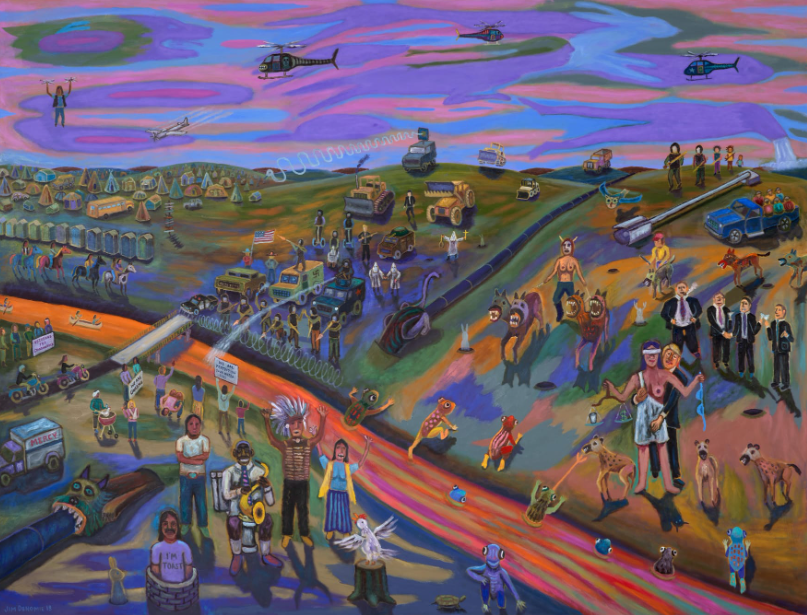
[Jim Denomie, “Standing Rock, 2016,” 2018]
Genuine democracy, in contrast, demands that our social relations have the capacity to embrace the many divergent social perspectives that are inherent across the many communities that make up our country. In other words, genuine democracy requires respect and engagement across all sectors of society, and this can only be achieved by cultivating relationships that in actual practice are able to listen and respond with respect for each other’s humanity—that are able to, in a word, act with love.
This ability to act with love—to build a future where the current degradations impinge less fully upon persons and communities—has, in fact, been a characteristic of local, national, and global struggles across all of human history. The current instantiation of White supremacy and heteropatriarchal norms have always been struggled against by the people and communities who are the targets of these norms. Quan gives us many illustrative examples of these struggles: from the peasant insurrections in China in 209-207 BC, to Gabriel’s Slave-Rebellion of 1800, to the struggle against the violence directed at Asian and Pacific Island Communities during COVID-19, to the rebellion against the Foxconn factory (producer of iPhones) in Wuhan, China in 2011, to Black Lives Matter (BLM) and the Movement for Black Lives (M4BL), and to the many struggles of queer and trans people of color.
When communities recognize the effort to degrade their own humanity, they reject those gestures through creating profoundly powerful relations of love and care that are also committed to seeking justice. Quan shows us how each of these examples reveal “different praxes of being human,” which engender “alternative meanings for justice and ethics of living” (3). Each of these movements have directly confronted state practices that degrade humanity, and in their place construct alternate relationships wherein communities of love, care, and mutual responsibility can function. Once we recognize this rich and powerful history of struggle, as it has been and continues to be present in our social and political lives, we discover and sustain praxes of genuine democracy in which the value and respect for ourselves and each other cannot be extinguished by the formal functions of government.
Become Ungovernable offers us a different way of being in struggle that stretches across our most intimate sense of self to our broadest immersion in the systems of meaning instantiated by our socio-historical-cultural-governmentality situation. To participate in practices that we might legitimately call justice-seeking thus requires a kind of epistemic and embodied stretching. We become ungovernable by conceiving of “justice as compassion and in solidarity,” by drawing attention “to the ways in which willful subjects and communities imagined and fought for justice” and thus cultivating “justice as praxis” (14). Viewing justice “as compassion and in solidarity signals that as much as solidarity is praxis, a strategic coming together, justice is necessarily about living in mutuality” (158). In this way, “justice itself is praxis and relational; being just is thus an orientation toward just futures, even if the extant lifeworld is far from just” (158). The radicality of this move cannot be overstated.
To seek social justice is a very demanding effort. Social justice must be more than an abstract idea. It requires an ongoing assessment of what is real. To claim that one is seeing what is “real” is a huge assertion to make. It is an assertion that is, in one sense, value neutral because what appears to me in my perception as “real” simply is. The predicates that lead me to see what I see as “real,” on the other hand, are never value neutral because they are precisely what connects my “real” to the value-laden historical trajectories in which I am immersed and which I have the power to impact. Or as Quan, quoting Angela Davis, notes: “The ability to experience compassion for the other requires our ability ‘to achieve not only insight but also an impartial perspective on our own and others’ inner states’—a habit of modal imagination” (164).
Part of the challenge of finding a way of being human that stretches across our most intimate sense of self to our broadest immersion in the systems of meaning instantiated by our socio-historical-cultural-governmentality situation is that we can easily come to rely on social identities of victimhood or vulnerability. Social and political vulnerability creates victims, and any effort to seek justice must recognize the reality that people are victimized by social structures. However, we must be cautious and not let that fact lead us to make social vulnerability into an identity that positions us as eternal victims.
The fact that one is, for example, a victim of widespread misogyny, can make one a very good advocate for gender and sexual justice. But such advocacy can also simultaneously miss related vulnerabilities as those that come with racial and gender non-binary status. Each type of vulnerability, each type of victimization must be seen as part of systems in interrelations that function beyond the identification of any one type of violence. Each circumstance of victimization through dehumanization offers an opportunity to deepen our understanding of the predicates that make some greater targets of violence.
In other words, it is important to reject the ontologizing of vulnerability as a kind of permanent “positionality” for political mobilization. Rebellion against oppression requires both recognizing how social identities are mobilized by the state to protect and serve the interest of the elite and their control of governance, as well as how to use those very social identities as a source for collective action. To become ungovernable means that we must appreciate how “the very process of identity and consciousness formation are entangled in acts of mutuality and relationship building. [It is why Mohanty] notes that ‘the home, community, and identity all fit somewhere between the histories and experiences we inherit and the political choices we make through alliances, solidarities, and friendships’” (170).
Notes
[1] For more information on fascism in the United States, see Rachel Maddow. Prequel: An American Fight Against Fascism. New York: Crown, 2023 and Alberto Toscano. Late Fascism: Race, Capitalism and the Politics of Crisis. New York: Verso, 2023.
References
Quan, H.L.T. Become Ungovernable: An Abolition Feminist Ethic for Democratic Living. London: Pluto Press, 2024.

Dr. Jacqueline M. Martinez (she/he/they) is the current President of the Caribbean Philosophical Association. Dr. Martinez studies communicative experience as it structures possibilities for human expression and perception within contexts of power. Dr. Martinez’s publications include Phenomenology of Chicana Experience and Identity: Communication and Transformation in Praxis (2000) and Communicative Sexualities: A Communicology of Sexual Experience (2011). Dr. Martinez is a Professor of Communication at Arizona State University.