Reading Sycorax in Silence

By Dana Francisco Miranda
My summers seem to always begin and end with reading. From childhood reading challenges at my local library to the rigorous reviews conducted for research and teaching, I have long since been immersed in the kingdom of literacy. However, this also means being trapped within endless pedagogical discourses surrounding illiteracy, or rather failures of reading. After five years of publication, Caliban’s Readings also continues to be read, unread, and ill-read throughout the world. In the following, I want to speak to the multiple types of reading that are still possible with/in this digital sight.
In “My Students Can’t Read,” Tyler Jagt outlines a general literacy crisis within academia, noting that there is a “measurable, generational collapse in sustained reading and writing, and the academy is responding to it with improvisation and exhaustion rather than the structural overhaul it requires” (1). This decline in reading for Jagt is multi-causal, ranging from an over-reliance on technology all the way to institutional mismanagement, but importantly is an indictment on education itself.
However, this crisis in literacy is not new. Stephen Nathan Haymes has argued in “‘Us Ain’t Hogs, Us Is Human Flesh’: Slave Pedagogy and the Problem of Ontology in African American Slave Culture,” that literacy was essential in the face of reading bans and criminalization. However, literacy goes beyond the ability to read and write—to be literate one also must engage in pedagogies that attend to collective pain, uproot domestication, and orient enslaved people to a more liberating and affirmative lifestyle. Pedagogy, rather than being reduced to teaching literacy, was instead a means of transmitting values under the duress of servitude: “The goal of slave pedagogy as a philosophical stance was to orient the slave toward choosing a way of life that affirmed his or her worth as a human being” (131).
Literacy is thus crucially a means of seeing and judging values and orienting oneself accordingly. It is reading the situation while also knowing that one is continuously being read or interpellated by the definition of others. One should therefore be careful of the readings they adopt. Under Prospero’s Gaze, Caliban reads himself as inferior. Thus, even as he curses and maligns his domination, ultimately his resistance quickly diminishes under the Look and power of a master. [1] This can be seen even in Aimé Césaire A Tempest [Une Tempête], where Caliban laments: “You ended up by imposing on me an image of myself: underdeveloped, in your words, undercompetent that’s how you have made me see myself!” (62).
In a similar fashion, in Black Skin, White Masks [Peau noire, masques blancs], Frantz Fanon identifies the gaze of a small French child as being both disorienting and debilitating. Accosted by the phrase, “Look! A Negro!”, Fanon notes the ways in which he is read only as a phobogenic object. [2] This, of course, also includes being read alongside disparaging stereotypes regarding black people. He thus writes: “I stumbled, and the movements, the attitudes, the glances of the other fixed me there, in the sense in which a chemical solution is fixed by a dye” (109). While this lived-experience is itself illustrative of the effects of antiblack racism, it is also instructive. For one can become literate in the ways of looking back and reading otherwise.
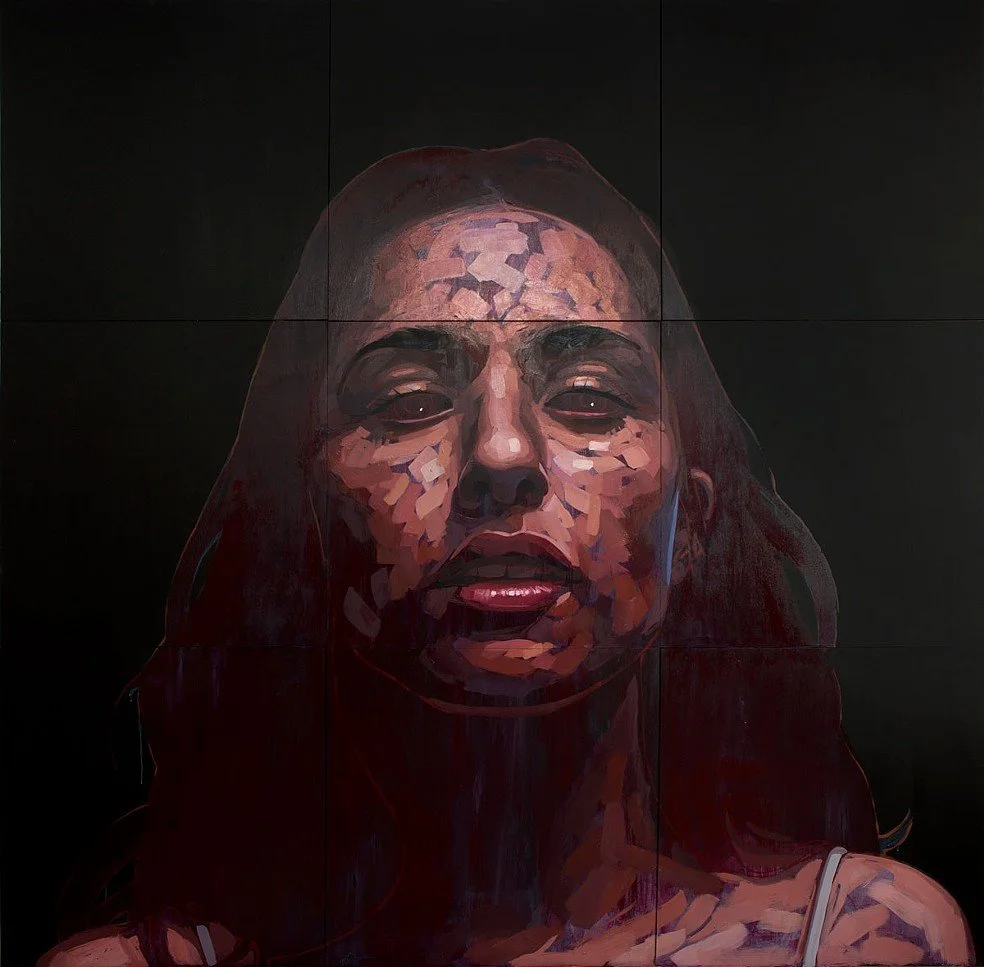
[Abdul Abdullah, “Sycorax, 2016,” 2015]
For W.E.B. Du Bois, this is most apparent in “The Souls of White Folks” where the modern notion of whiteness is critically examined. What is important here is that Du Bois bases his understanding of whiteness to a practice of seeing. Du Bois states: “Of them I am singularly clairvoyant. I see in and through them. I view them from unusual points of vantage.... I see the working of their entrails. I know their thoughts and they know that I know” (29). Just as whiteness seeks to define blackness, it is also wary of being witnessed by that which it dismisses. In other words, whiteness also fears being read through the interpretative schemas announced by the refrain: “Look! A White!”
That said, this type of loud reading is not always conducive. Oftentimes, this reverse-Gaze leads to deflection or even violent subjugation by those seeking to avoid being read. [3] It is thus often the case that literary practices must rely on secrecy and subterfuge—techniques to avoid detection. This is equally true for those facing enslavement to those facing repression and colonialism. [4] For instance, Suzanne Césaire within her work and life noted how the Caribbean itself was continuously misread, while also weaponizing that illiteracy to produce radical work hidden in plain sight. In The Great Camouflage [Le Grand Camouflage], she writes that “If my Antilles are so beautiful, it’s because the great game of hide and seek has worked, it’s because it must certainly be too lovely and bright, on that day, to see clearly” (46). Reading the Caribbean as beautiful is to misread how violence is sutured into the very conditions that make the ugliness of domination invisible.
Ironically, this self-induced blindness also allows Césaire to keep producing fourteen issues of Tropiques, the journal in which “The Great Camouflage” was first published. This was done all while Martinique was under the control of Admiral Georges Robert and the Vichy government. While the literary magazine was briefly censored by Lieutenant de Vaisseau Bayle in 1943, for much of its early run, its ideas existed openly for those who could read properly. [5] For colonial censors, the language of surrealism hid a radical underbelly. Dissimulation and deception—whether intentional or unintentional—thus have the power to both protect and liberate.
There are, however, types of misreading that fail to see not because of deception but rather due to acts of spoilation. Consider the crime of Sycorax’s erasure. In The Tempest, Sycorax—the Algerian mother of Caliban—is often considered a minor character, present in the story only as a past ruler and practitioner of dark magic. In contrast, A Tempest depicts Sycorax as being alive, although still violated: Hence, Caliban cries: “Dead or alive, she was my mother, and I won’t deny her! Anyhow, you only think she’s dead because you think the earth itself is dead.... It’s so much simpler that way! Dead, you can walk on it, pollute it, you can tread upon it with the steps of a conqueror. I respect the earth, because I know that it is alive, and I know that Sycorax is alive. Sycorax. Mother” (12).
But more than violation, spoilation names the destruction and hiding of evidence. It names the discursive practices that have made Sycorax a “presence/absence” or an “inactive silence” within even anticolonial discourses. [6] For instance, it is the figure of the unimagined “Caliban’s woman” that is central to Sylvia Wynter’s theorization of race-making and sex-gender differences. While Caliban serves as the physiognomic model of racial difference—the “monstrous” Other to Man—his racialized mate is noticeably absent.
It is also this very absence that also negates the allegorical power of racialized women to serve as alternative sources of meaning. Hence, Wynter writes in “Beyond Miranda’s Meanings” that “the absence of Caliban's woman, is an absence which is functional to the new secularizing schema by which the peoples of Western Europe legitimated their global expansion as well as their expropriation and/their marginalization of all the other population-groups of the globe, including, partially, some of their own national groupings” (361-62). If Sycorax exists on the “silenced ground” of patriarchal power, “Caliban’s woman” stands upon “demonic ground.”
The figure of “Caliban’s woman” and Sycorax, however, need not be in direct tension. In “Tempestuous Maternities: Plotting Gender and Genre with Sylvia Wynter and Silvia Federici,” Annie Menzel critically examines how Sycorax can be a model for a “universe of feminine refusals, disruptions, and rebellions against that order, from marriage and family to the plantation itself” (118). Moreover, one can find both silence and spoilation within “demonic grounds.” This can be seen in the heteronormative assumptions regarding the genre/gender of Caliban’s mate or the mono-normative assumptions regarding singular desires and relationships. This act of erasure can also be seen in the very naming of this blog.
By enacting the figure of Caliban, I have also silenced certain refusals and relationships. Fortunately, this need not be permanent. As Irene Lara argues, in “Beyond Caliban’s Curses,” this site can also develop a Sycoraxian literacy where such absences are made explicitly present. This includes those not only underrepresented and misrepresented, but also those who remain unseen. Importantly, Lara notes that such a literacy would also be a “literacy of healing” that would mend “discursive distortions and fears of the interrelated racialized concepts of the female sex, spirituality, and sexuality so that we can create relations with ourselves and others beyond the oppositional relations signified by Caliban’s language of cursing” (82).
Let us thus wish for more summers of struggling with literacy. Let us wish for more readings that uncover the unseen. Through both our curses and our supplications, we may yet make this a site that is revolting.
Notes
[1] It is important to note the distinct endings of Caliban for both Shakespeare and Césaire. In the original production, Caliban seeks to be pardoned by Prospero and is eventually freed, whereas in the latter Caliban is heard still singing for a different kind of freedom—one that is untethered to masters or tyrants. In other words, Shakespeare's Caliban is pacified while Cesaire’s is still threatening.
[2] For more on the historico-racial and racial epidermal schemas produced through antiblack racism, see Sujaya Dhanvantari. “Frantz Fanon: Il faut faire peau neuve.” Caliban’s Readings. March 4, 2025.
[3] For more on this Gaze or Look, see Linda Martín Alcoff. “Caliban’s Phenomenological Ontology.” The CLR James Journal 14-1 (2008): 9-25. She writes: “The master or colonizer wants, understandably, to avoid seeing himself as he appears in the eyes of his slave, for therein can lie only guilt, accusation, and blame. Thus the master seeks to deflect this Look by transcending the slave’s transcendence...through a racism that erases the slaves subjectivity or power to judge, to value, and to impose meaning” (13).
[4] For more on literacy practices and learning during slavery, see Grey Gundaker. “Hidden Education Among African Americans During Slavery.” Teachers College Record 109-7 (2007): 1591-1616 and Janet Cornelius. “‘We Slipped and Learned to Read:’ Slave Accounts of the Literacy Process, 1830-1865.” Phylon 44-3 (1983): 171-186.
[5] For more on Tropiques and Suzanne Césaire, see Jennifer Anne Boittin. “‘The Great Game of Hide and Seek Has Worked’: Suzanne Césaire, Cultural Marronnage, and a Caribbean Mosaic of Gendered Race Consciousness around World War II.” French Colonial History 20 (2021): 145-173.
[6] For more on the erasure and silencing of Sycorax, see Abena P.A. Busia. “Silencing Sycorax: On African Colonial Discourse and the Unvoiced Female.” Cultural Critique 14 (1989-1990): 81-104.
Césaire, Aimé. A Tempest. Translated by Richard Miller. New York: Theatre Communications Group, 2002.
Césaire, Suzanne. The Great Camouflage: Writings of Dissent (1941–1945). Middletown, CT: Wesleyan University Press, 2012.
Du Bois, W.E.B. “The Souls of White Folk.” Darkwater: Voices From Within The Veil. New York: Harcourt, Brace and Company, 1920.
Fanon, Frantz. Black Skin, White Masks. Trans. Charles Lam Markmann. London: Pluto Press, 1986.
Haymes, Stephen Nathan. “‘Us Ain’t Hogs, Us Is Human Flesh’: Slave Pedagogy and the Problem of Ontology in African American Slave Culture.” Educational Studies 32 (2001): 129-176.
Jagt, Tyler. “My Students Can’t Read.” The Chronicle of Higher Education. June 1, 2026.
Lara, Irene. “Beyond Caliban’s Curses: The Decolonial Feminist Literacy of Sycorax.” Journal of International Women’s Studies 9-1 (2007): 80-98.
Menzel, Annie. “Tempestuous Maternities: Plotting Gender and Genre with Sylvia Wynter and Silvia Federici.” Theory & Event 26-1 (2023): 99-127.
Wynter, Sylvia. “Beyond Miranda’s Meanings: Un/silencing the ‘Demonic Ground’ of Caliban’s ‘Woman.’” Out of the Kumbla: Caribbean Women and Literature. Eds. Carole Boyce Davies and Elaine Savory Fido. Trenton, NJ: Africa World Press, 1990: 355–370.
Dr. Dana Francisco Miranda is a Senior Editor for Caliban’s Readings. He currently serves as the Secretary of Digital Outreach & Chair of Architectonics for the Caribbean Philosophical Association. He is an Assistant Professor of Philosophy and Faculty Fellow for the Applied Ethics Center at the University of Massachusetts Boston. His research is in political philosophy, Africana philosophy, phenomenology, and psychosocial studies. His current book manuscript, “The Coloniality of Happiness,” investigates the philosophical significance of suicide, depression, and wellbeing for members of the African Diaspora. Follow him on Twitter @DanaFMiranda.