Love in Ordinary Spaces: Queer Field Notes from Guyana

By Preity Kumar

[Preity Kumar, “#63 Beach,” 2015]
1. No Quiet Place
A little white wooden colonial building with green shutters sits on Carmichael Street in Georgetown, Guyana. Inside, it is tightly packed and filled with local music, the scent of Guyanese food, and the hum of conversation. Tina, a mixed-race woman in her 20s, arrived twenty minutes late—true to the Caribbean rhythm of never being on time. She ordered a juice, a bake, and eggs. I ordered a coffee and my favorite pastry, a pine tart. Meeting her for my first interview, I felt the nerves of returning to a place that had always been part of me yet now felt both familiar and strange—this is what it meant to have a diasporic body.
Like so many Guyanese families, mine had migrated to Toronto, carrying with us the stories of home. During my PhD, I realized I needed to return—to follow the stories of women loving women that had always been there—and stepping into this café, I anticipated those stories and feared them. A mixed-race hostess behind the counter, impatient that we were taking too long to order, scanned our bodies with suspicion. Did she suspect something? What was that “something?” We got a table at the back of the cafe, but the chatter and the music was too loud to hear each other, much less record a conversation. The tables felt too close. Tina quickly suggested that we leave and take a drive since she had a car and asked if I would be comfortable conducting the interview elsewhere. We didn’t drive elsewhere. Instead, we remained in the car for over an hour, moving between questions about her life.
Where and how does queer intimacy unfold when there are no private and public spaces for bodies like hers and mine?
I would quickly learn that queer intimacy in Guyana is not primarily organized around identity or visibility. Queer life, at least for women, is structured around exposure—exposure to interruption, surveillance, class and racial differences, as well as violence. [1] In this landscape, queer intimacy and love is not a private refuge; it is something practiced without infrastructure, even as we tried to find shelter for this fragile connection. We tried cafes where the music swallowed our voices, libraries that had no private rooms, and hotel lobbies where security watched us sit for too long. We tried public benches where men slowed down to stare and catcall. We kept trying, all the time moving—lowering our voices, shifting our bodies, and sometimes, silence filled the spaces between us.
I met Grace (mixed-race, 20s) at City Mall with plans to interview her there, but the space was already too exposed. But before we could leave, a woman sat down at our table. Grace and I looked at her curiously. Just as I was about to ask her name, she told us that her husband had died of cancer. She had married at sixteen. She had four small children and sold chicken to survive. She kept saying she did not know how to live without love, without a companion. “We don’t know how to love,” she said, “or how to make sure someone loves us.” All her life she cooked and cleaned. When she was sick, he could not even make her a meal. She confessed this to us, strangers. Then she stood up and left. I would never learn her name.
In Life and Words, Veena Das writes that violence “attaches itself with its tentacles into the everyday life and folds itself into the recesses of the ordinary” (1). Listening to this anonymous stranger, I realized love also attaches and seeps into our pores. Love in this space did not settle comfortably; it continuously adjusted to the possibilities of interruption and surveillance. Grace and I walked away, confused by the encounter but shrugged it off. We passed through the bus park and stopped for a snack. We went to a benab around the back, but people kept coming and going. I felt watched so we left again. On Church and Main St, we sat on a bench in the middle of the city and talked about Grace’s life. I kept thinking about the woman at the mall. About how she needed somewhere—anywhere—to speak about love. Das reminds us that “life [is] recovered not through some grand gestures in the realm of the transcendent but through a descent into the ordinary” (7). If we struggled to find a place to sit and talk, it was not because love did not exist. Love persists within the ordinary, even when it must adjust.
2. Sorted by Space
Some places are said to be safe. Others are dismissed with a glance or a word. Cara Lodge in Georgetown is now a landmark and boutique hotel with tropical art and a posh bar for upper-class Guyanese and foreigners. It is also known for hosting dignitaries such as King Edward VIII in 1923, Jimmy Carter in 1996, and British Royalties throughout the 2000s. Lisa (mixed-race, 20s) had no trouble sitting there, ordering food and drinks as we talked. It did not occur to her that I might not have that kind of money to spend there. Before meeting Jenna (Indo-Guyanese, 30s), she messaged me saying, “hey, so don’t think we can just go and lime @ cara… wud hafta buy ting and I ain’t got it like that, so behind library, there r some benabs n is usually quietish.” The message stayed with me. Respectability had a texture. It was expensive and required money. It required the right kind of visibility.
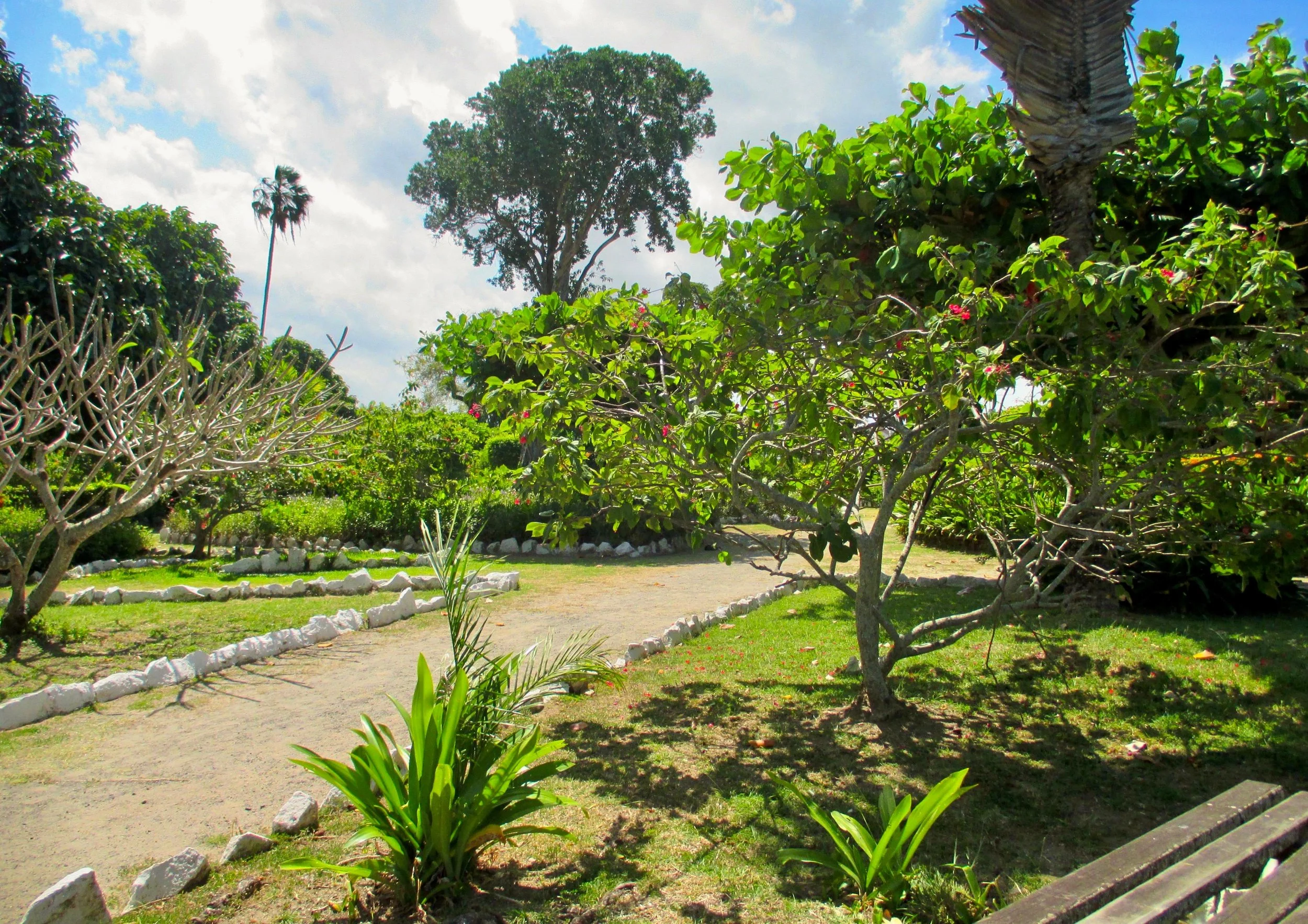
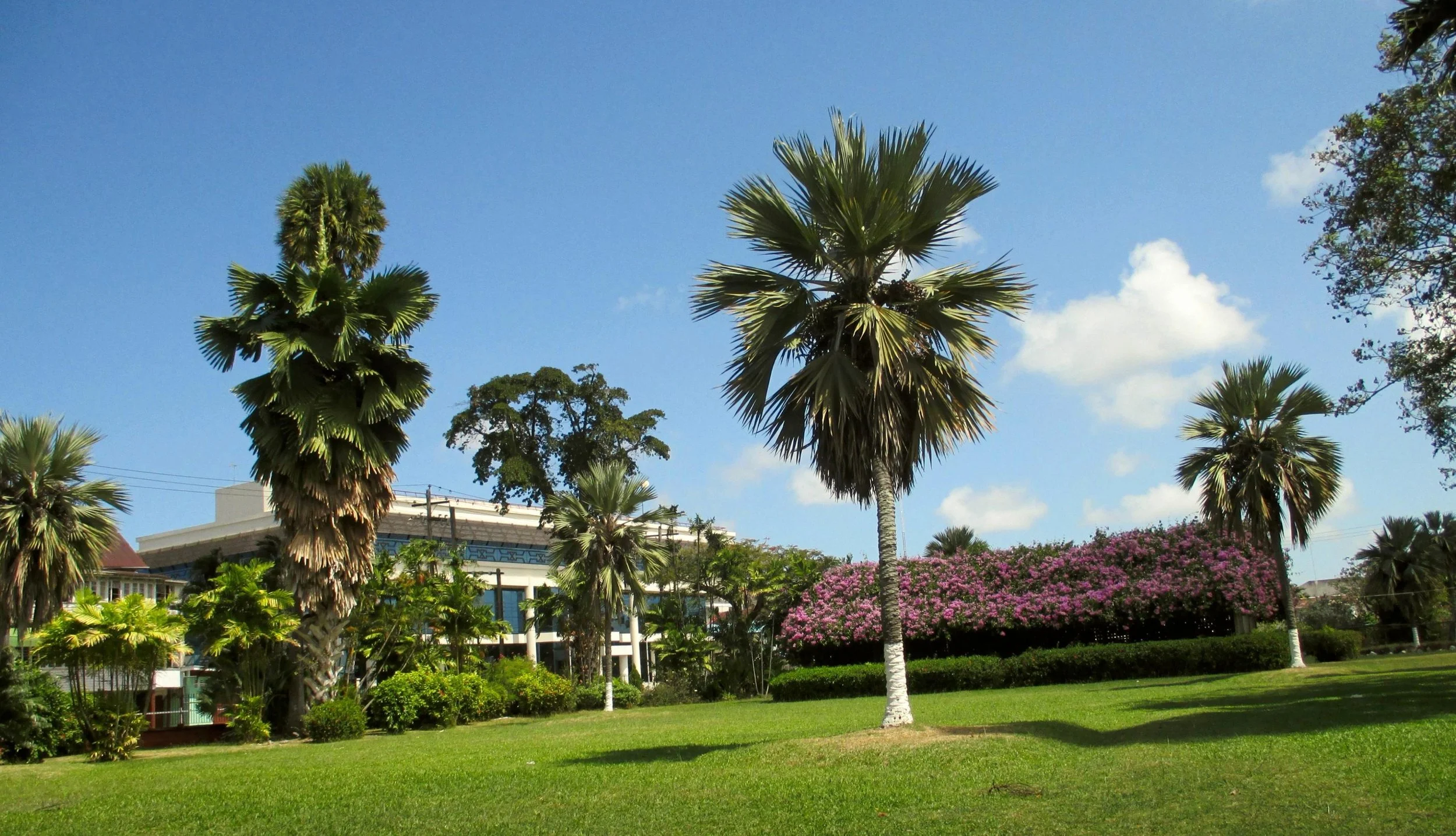
Promenade Gardens, on the other hand, is a historic space associated with colonial military use and the public execution of enslaved people. After the 1823 uprising, the Gardens were transformed into a public park with fountains, a bandstand, and a statue of Mahatma Gandhi that commemorated Queen Victoria’s Diamond Jubilee in 1897. Its serene appearance is constantly interrupted with maintenance crew, teenagers ditching school, and couples strolling around. It is also filled with black and brown bodies at work. In Thiefing Sugar, Omise’eke Natasha Tinsley reminds us that Caribbean landscapes were never passive backdrops of colonial governance, rather land was remade and reshaped through such labour. She writes: “Landscape—which is not trees, rivers, or flowers, but an imaginary way of organizing these into a ’whole’—in fact appears not as a preexisting entity but as a continual practice: one that, like the invention of womanhood, proves subject to constant disruption and rerouting“ (16).
In the Gardens, I met working-class women like Jackie (mixed-race, 20s) and Diana (mixed-race, 20s). As we sat together, security guards would slow down their pace and ask what we were doing. Talking, we would say. Just talking. Jackie said it with a smile: “people meet here, in all corners of the park, people sell sex here. Everyone knows…they probably assume we doin’ that.” It was common knowledge. This knowledge though shaped how we moved, how close we leaned into the recorder, and how we were watched. In my interviews with working-class women, the Gardens was neither a site of danger nor of safety, rather queerness and labour dictated the rules of the space.
[Preity Kumar, “Promenade Gardens, Georgetown, Guyana (#1),” 2015]
About seven miles outside of Georgetown, the village of Mon Repos—French for “My place of rest”—is famous for its local market. It also well-known for having a local bar that offers working-class LGBTQ communities’ anonymity. No one knows who is coming or from where they come. When I visited the local bar, it contradicted everything I assumed about rurality and queerness—about danger, exposure, and risk. Here, a rural bar was offering safety that the city could not. Upper-class women, though, like Sandra (mixed-race, 30s) and Anna (mixed-race, 30s) wouldn’t “put themselves there.” That place is “ghetto, we don’t do ghetto.”
[Preity Kumar, “Promenade Gardens, Georgetown, Guyana (#2),” 2015]
In rural Berbice, space itself shaped queer desire and expressions. The geographical layout of villages and tight-knit communities produced an atmosphere where everyone could track each other’s movements. Gossip travels fast. At a hotel in the regional capital, New Amsterdam, I met Mina (Indo-Guyanese, 20s) during her lunch break. The privacy of eating at a hotel restaurant during a workday offered temporary suspension from the public gaze. Since she lived at home, the hotel became our temporary space of freedom.
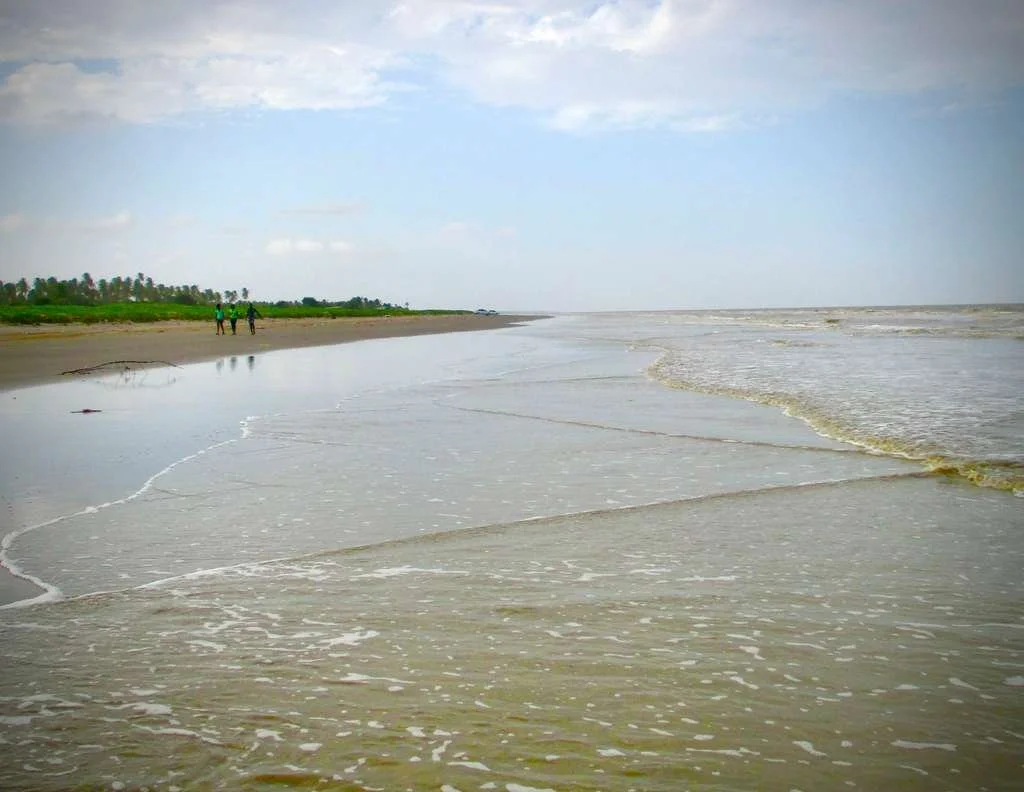
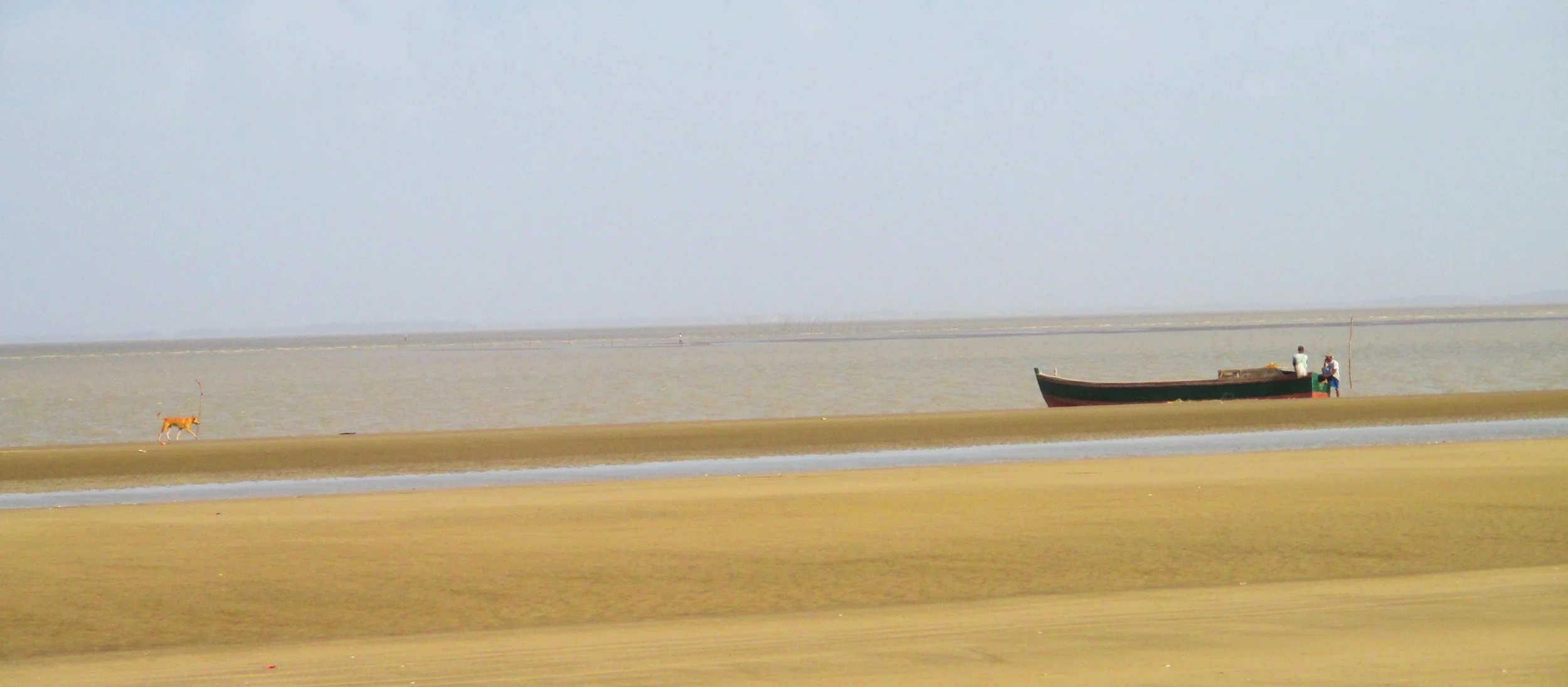
For working-class women, the logistics was much harder. Most of them lived with their families, worked, or had children to attend to. Yet, they all suggested meeting at #63 Beach in Berbice, famous throughout the country as a Sunday gathering place. This strip of the Atlantic coast provided respite from the monotony of rural living. As a child, excitement came from knowing that on Sunday mornings people from my village would gather to go to the beach to offer prayers. By early afternoon, the beach would transform into a lime—a party scene. The sand would be filled with rows of buses, temporary dugouts for fire, pots and pans, and the aroma of chicken curry and cook-up rice replaced the smell of burning incense.
[Preity Kumar, “#63 Beach, Berbice, Guyana” 2015]
On Sundays, I would travel from Georgetown to # 63 beach to interview working-class women. Here, with Amanda (mixed-raced, 30), her partner (Indo-Guyanese, 30s), their children and extended family, queer life unfolded within the public gaze. In “What the Sands Remember,” Vanessa Agard-Jones writes that the sand “provides a model for… understanding the memory of same-sex desire…as diffuse yet somehow omnipresent” (340). Walking along the shores, careful not to drop my recorder, I listened to the women’s stories of failed marriages, domestic violence, and their choices to carve out a life with partners in small villages. Their queerness was like the sand under our feet—soft, shifting, never fixed, but always leaving traces on space itself. Their queerness was not folded into rurality but existed through it.
Spaces didn’t just hold us.
It sorted us.
[Preity Kumar, “#63 Beach - Boat and Dog, Berbice, Guyana” 2015]
3. A Container
Speaking in public does something to your body. Something happens to language. Sentences are left unfinished, stories are fragmented, and details of memories are swallowed before they are spoken out loud.
Women spoke anyway. Violence appeared in their stories without always being named—masked as concern, stress, or simply care. Here the safety of participants could be stressed, institutionally protected, and carefully outlined in consent forms. [2] But what of the researcher? I struggled with my own protection, with my listening, and with my impulse to intervene—to offer solutions. Moreover, while interviews always end, contact with participants did not. Text messages, updates, and daily life struggles would be relayed to me. Some participants confused the intimacy of narration during fieldwork with personal intimacy, and so refusal came with a cost.
At times, our arms would brush together, or a woman would hold my arm longer than a moment. Protection? Desire? Care? Habit? I could not always tell what these gestures meant. I was aware of my own body—how I stood, how I smiled, or how my proximity might invite or foreclose. I learned quickly how queer intimacy can appear as a threat, an invitation, or an excess in public spaces. Safety was never assumed, so queerness must happen under interruption, under being watched.
Consent forms had not prepared me for this. But perhaps methodology itself is also unprepared, and unable to account for such intimacy. It is for this reason that Julietta Singh, in No Archive Will Restore You, argues that this dynamic “is not a material problem for my body archive, but also an affective one” (31). I became a container, absorbing stories, holding pain, and hope. Affect theory gave me a language for what my body already knew—that attachment, vulnerability, refusal, and care shape queer fieldwork. In other words, queer fieldwork demands a body to contain what cannot be resolved or what remains excessive.
4. Love without Guarantees
I had assumed I knew what love was. I also assumed everyone had access to love. In Guyana, I began to understand love differently. Not as romance or desire. Love, here, was practiced under conditions of survival, companionship, tenderness, but never guarantees. This realization weighed on me like a blanket of guilt and shame because I could leave. This realization followed me into conversations, along streets, and interrupted moments of connection with women. I could leave and return at my own choosing, but no act of leaving is ever clean.
Love rearranged what I thought I was listening for and sat in my body. At Hibiscus restaurant in Georgetown, I watched Sandra wink at her partner across the table—playful, and then quickly vanish like a hummingbird. Even with the echoes of her past abuse, Sandra’s promised love to someone. A small gold ring, ordinary, yet extraordinary marked a refusal to be quite in a landscape that refuses to recognize their love in law. [3] Later that night, in her home, the smell of spices and fried plantains, photographs on their walls, dishes to put away, were all fragments of their lives held together. Knowing their life—both their past and wishes for their future—pressed differently into my body. A love lived in the ordinary: the way food and protection was offered to me, insisted that queer love thrives in the messy, the hidden, and in the persistent.
At a panel, someone once asked me why I don’t write about love. How could I answer? I don’t know what love is, or how to love. And yet, I’ve felt it in small, ordinary ways: when someone handed me a Banks Beer at a bar—and it tasted like molasses and brown sugar—or when a participant worried about my safety so much that they offered to drive me across the Demerara River to Parika. I watched a woman dance to the cool Atlantic air, and I thought about a life in a space that was of me but no longer mine. Could I say this is love? Would the audience have understood it?
To love in Guyana is not to escape danger, exposure, or hide yourself away. Queer love doesn’t promise anything; it doesn’t solve anything—but it certainly matters. However brief and unprotected, queer love matters because it is real. I came to understand that love between women unfolds under the public gaze, persisting without institutional support and often without the promise of permanence, in conditions where violence is unevenly distributed and frequently unnamed. Queer love mattered not because it overcame violence, but because it endures alongside it as “oblique permanence” (340). [4] Queer love persists across time and space, leaving traces of itself in ordinary acts. I have come to understand that love inhabits space without permission.
There is still no quiet place.
This is not a failure of queer life—but one of its most vulnerable forms.
Notes
[1] I use exposure rather than visibility to signal vulnerability rather than recognition. Visibility suggests spectacle, mobility, and public legibility. Exposure, by contrast, names an ongoing condition—the ways in which queer life is rendered susceptible to harm, discipline, and scrutiny without necessarily being seen or acknowledged.
[2] These interviews were conducted as part of my doctoral research and approved through the York University Research Ethics Board. Fieldwork was carried out in Guyana between 2015-2016. All participants provided informed consent. Pseudonyms were used, and all identifying details were changed to protect participants’ privacy and safety.
[3] Same-sex marriage is not legally recognized in Guyana. Colonial-era laws regulating same-sex intimacy remain on the books, such as sodomy laws, through enforcement is uneven. In 2018, Guyana’s crossing-dress law was struck down, making a significant legal shift for gender non-conforming and trans people. Sexual and gender minorities continue to navigate a landscape shaped by legal ambiguity, social stigma, and violence.
[4] In “What the Sands Remember,” Agard-Jones, describes ‘oblique permanence’ as queer lives and desires that endure over time and through social practices, even when they remain indirect, subtle, or absent from conventional historical records.
References
Agard-Jones, Vanessa. “What the Sands Remember.” GLQ: A Journal of Lesbian & Gay Studies 18:2–3 (2012): 325-346.
Das, Veena. Life and Words: Violence and the Descent into the Ordinary. Berkeley, CA: University of California Press, 2006.
Singh, Julietta. No Archive Will Restore You. Santa Barbara, CA: Punctum Books, 2018.
Tinsley, Omise’eke Natasha. Thiefing Sugar: Eroticism between Women in Caribbean Literature. Durham, NC: Duke University Press, 2010.

Dr. Preity R. Kumar (she/her) is an Assistant Professor in the Department of Gender and Women’s Studies at the University of Rhode Island. Her monograph, An Ordinary Landscape of Violence: Women Loving Women in Guyana (Rutgers Press, 2024), investigates the ways queer women navigate and reproduce harm within a hetero-patriarchal society. Dr. Kumar’s research has been published in international journals and volumes across the United Kingdom, the Caribbean, and Poland, including the Journal of Indentureship and its Legacies, Journal of Lesbian Studies, InterAlia: A Journal of Queer Studies, Middle Atlantic Review of Latin American Studies, and the Routledge Companion to Applied Qualitative Research in the Caribbean.